6 Situations Where a Gravity Spiral Chute Improves Product Handling

How Conveyor Clutch Systems Improve Precision and Reliability in Index Conveyor Applications
June 18, 2026
Positive Drive Vs. OutRunner Spirals for Freezing Applications
August 19, 2026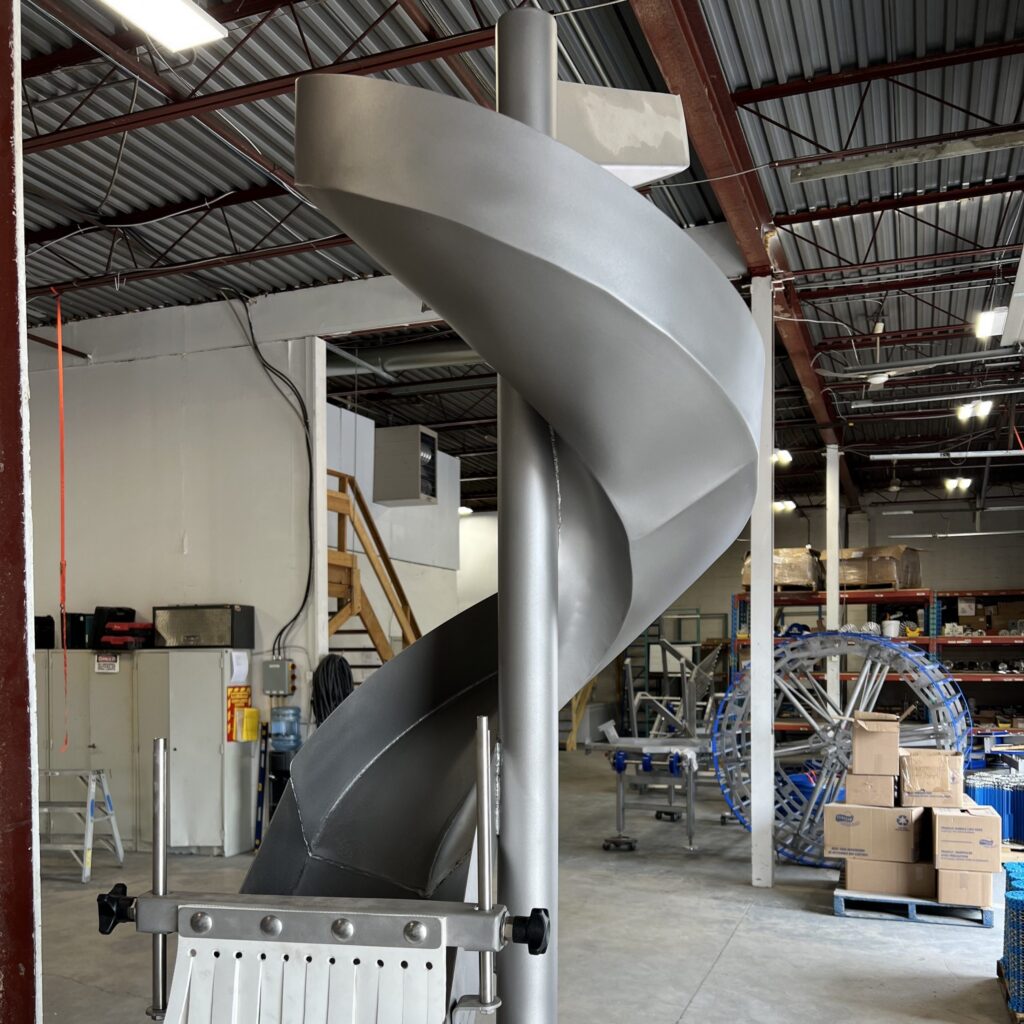
Moving product between elevations is one of the trickier problems on a food or packaging line. When items need to drop from a high process point to a lower packing area, the transition can bruise, crack, or slow down the whole operation. A gravity spiral chute solves this by using a coiled, downward path that lets the product descend at a controlled speed without powered equipment. It relies on gravity alone, which keeps the design simple and dependable.
Below are six situations where this approach makes a real difference on a production line.
Lowering Fragile Products Without Belt Driven Equipment
Fragile items such as baked goods, coated snacks, and molded plastics can suffer damage when they transfer between powered belts. A gravity spiral chute removes that risk by guiding the product down a smooth, curved surface at a steady pace. Because gravity does the work, there are no belt seams or drive transitions to jolt the product. The continuous spiral wall keeps items contained as they descend, so nothing tips or scatters. This protects delicate products and reduces waste on lines where breakage cuts directly into yield.
Moving Frozen Items From Elevated Lines to Packing Areas
Frozen and chilled products often leave elevated freezing equipment and need a clean handoff to packaging below. A spiral chute carries these items down without adding mechanical complexity near the cold zone. The enclosed, spiraling path keeps frozen pieces moving in order, so they arrive at the packing station ready to bag or box. Fewer powered parts near the cold area also means fewer components exposed to condensation and frost. This supports the same continuous flow that CONOVEY builds into its automated conveyors for food processors.
Saving Floor Space in Tight Production Layouts
Floor space is a constant constraint in busy plants. A straight decline needs a long run to lower product gently, which many facilities cannot spare. A gravity spiral chute coils that same descent into a compact vertical footprint, freeing valuable floor area for other equipment. By building the drop upward into a spiral rather than outward across the floor, plants gain the height they already have. For producers working within fixed building limits, this space efficiency often decides whether a layout works at all.
Reducing Energy Use With a Gravity Fed Design
Every powered component on a line draws energy and adds maintenance. A gravity fed design uses no motor to move product downward, so it consumes no power during operation. This lowers running costs and reduces the number of parts that can wear or fail over time. It also runs quietly, which improves conditions on the plant floor. On high-volume lines, pairing gravity descent with powered material handling solutions keeps energy use in check while maintaining throughput.
Handling Sensitive Foods That Break Easily
Some foods, such as cookies, chips, and portioned frozen items, break under even modest impact. A spiral chute controls the descent speed through its curved geometry, easing product downward instead of letting it free fall. The gradual slope absorbs momentum so items settle rather than slam at the bottom. The result is gentler handling that preserves shape and appearance. For sensitive product lines, this level of control protects both quality and presentation.
Fitting Custom Configurations to Existing Site Conditions
No two plants share the same ceiling height, column spacing, or discharge direction. A gravity spiral chute can be built in different diameters, incline angles, and entry and exit orientations to suit the space available. This flexibility makes it a practical fit for retrofits and new installations alike. A chute shaped around real constraints integrates cleanly instead of forcing changes to the surrounding line. Matching the chute to actual site conditions is exactly the kind of engineering CONOVEY applies across its thermal processing solutions and material handling equipment.
Choosing the Right Chute for Your Line
The situations above share a common thread: a product that needs to move down without getting damaged, and a plant that can’t spare the floor space or the extra energy to do it. A gravity spiral chute answers both at once. The real value comes from matching the chute to your specific product and site, since a design built around fragile baked goods looks different from one handling frozen portions or working within a low ceiling. CONOVEY engineers each chute around those exact conditions, so the design fits your line rather than forcing your line to fit the equipment. As a Canada- and USA-based manufacturer of industrial conveyors, CONOVEY serves manufacturers and system integrators worldwide.
Ready to improve product handling on your line? Contact CONOVEY today to design a gravity spiral chute engineered for your product, throughput, and plant layout.


- Various Drive Options
- Tapered Rollers also available
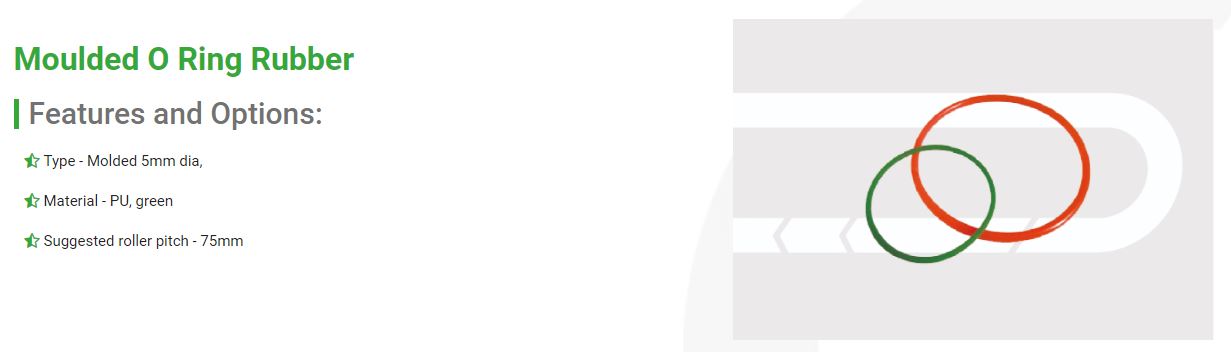
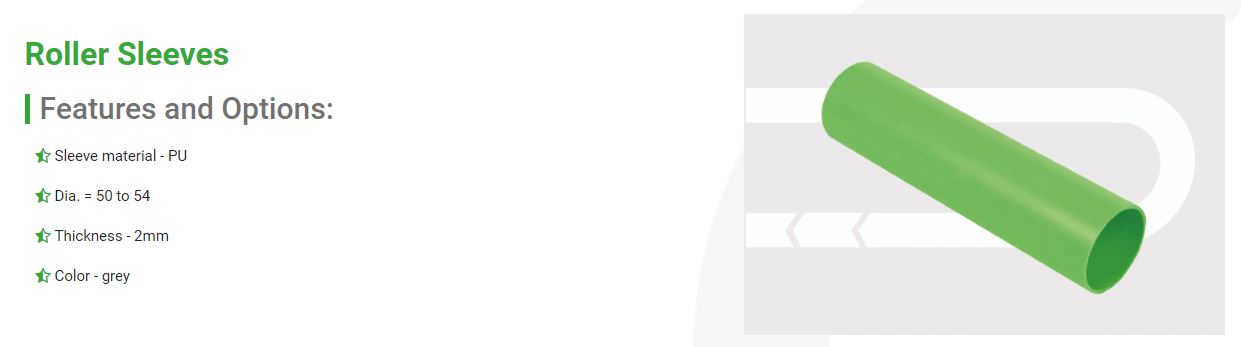
- Optional Polyurethane sleeving
- Variable speed is standard
- Safe low voltage & wide range of speeds
- 1201/1202 | Belt Rollers, Single or Double Groove Light/Medium Duty Conveyors Rollers, Custom Made Grooves | ⌀50mm Roller | ⌀11mm, ⌀14mm Shafts
- 1203 | Belt Pulley Rollers, Light/Medium Duty Conveyor Rollers | ⌀50mm Roller | ⌀11mm, ⌀14mm Shafts
- Suitable for wide range of application for Buffer or accumulation require
- Single drive with start/stop application suitable
- Single or double 14 teeth x 1/2” sprockets can be fitted (choice of steel or nylon sprockets)
- Mild steel and stainless steel options
- Stainless steel options available for all fixed driven conveyor rollers
- 1301/1302 | Polymer sprocket rollers, single or double sprocket, low running noise, polyamide bearing housing | 50mm Dia | ⌀14mm Shaft
- 1303/1304 | Steel sprocket, single or double sprocket, polyamide bearing housing | ⌀50mm Roller | ⌀14mm Shafts
- 1305/1306 | Steel sprocket, adjustable torque, single or double sprocket, polyamide/steel bearing housing | ⌀50mm, ⌀60mm, ⌀76 mm Rollers | ⌀14mm, ⌀15mm, ⌀20mm Shafts
- 1201/1202 | belt rollers, single or double groove light/medium duty conveyor rollers, custom made groove | ⌀50mm Roller | ⌀11mm, ⌀14mm Shafts
- 1203 | Belt Pulley Rollers, Light/Medium Duty Conveyor Rollers | ⌀50mm Roller | ⌀11mm, ⌀14mm Shafts
- Single and Double Grooves option
- Light and medium duty driven roller fitter with nylon O ring sprocket
- Line-shaft and 24V DC motorized rollers conveyors
- Mild steel, stainless steel and plastic options
- Stainless steel options available for all fixed driven conveyor rollers
- Free running bearings
- Wide range of tube and shaft options
- Wide range to handle from 100gm to 500kg per roller capacity
- Mild steel, stainless steel and plastic options
- Our most economical price rollers
- 1101 | PVC tube, polyamide bearing housing, light duty conveyor rollers | ⌀25mm, ⌀38mm, ⌀50mm Rollers | ⌀10mm, ⌀12mm Shafts
- 1102 | Light and medium duty universal conveyor rollers, polyamide bearing housing | ⌀25mm, ⌀38mm, ⌀50mm, ⌀76mm, ⌀89mm Rollers | ⌀14mm, ⌀20mm Shafts
- 1103 | Gravity conveyor rollers, steel bearing housing | ⌀50mm, ⌀76mm, ⌀89mm Rollers | ⌀14mm, ⌀20mm Shafts
- 1201/1202 | belt rollers, single or double groove light/medium duty conveyor rollers, custom made groove | ⌀50mm Roller | ⌀11mm, ⌀14mm Shafts
- 1203 | Belt Pulley Rollers, Light/Medium Duty Conveyor Rollers | ⌀50mm Roller | ⌀11mm, ⌀14mm Shafts
- 1204 | Poly V belt pulley rollers, medium duty and high speed conveyor rollers | ⌀50mm Roller | ⌀11mm, ⌀14mm Shafts
- 1205 | Timing belt pulley rollers, medium duty and high speed conveyor rollers | ⌀50mm Roller | ⌀11mm, ⌀14mm Shafts
- 1206/1207 | Polymer sprocket rollers, single or double sprocket, medium duty and low running noise, polyamide bearing housing | ⌀50mm Roller | ⌀14mm Shafts
- 1208/1209 | Steel sprocket, single or double sprocket, medium/heavy duty conveying application, polyamide bearing housing | ⌀50mm, ⌀60mm, ⌀76mm Rollers, ⌀89mm Roller | ⌀14mm, ⌀15mm, ⌀20mm Shafts
- 1210/1211 | Steel sprocket, steel bearing housing, heavy duty conveying, strong and reliable | ⌀50mm, ⌀76mm, ⌀89mm Rollers | ⌀14mm, ⌀15mm, ⌀20mm Shafts
- Free running option for gravity roller conveyors.
- All tapered conveyor rollers have a sealed bearing option for wash-down areas
- 50mm diameter base roller can be grooved for line-shaft conveyors
- Tapered sleeve rollers to suits an inside radius of 500mm to 1200mm
- Single or double 14 teeth x 1/2” sprockets can be fitted (choice of steel or nylon sprockets)
- Mild steel and stainless steel options
- Stainless steel options available for all fixed driven conveyor rollers
- 1401 | Gravity tapered roller, attractive look and low noise | ⌀53mm, ⌀56mm, ⌀50mm Rollers | ⌀12mm, ⌀14mm Shafts
- 1402 | belt drive, Double grooved tapered sleeve roller, customized groove position | ⌀53mm, ⌀56mm, ⌀50mm Rollers | ⌀14mm Shaft
- 1403 | belt pulley drive, Double grooved O belt pulley tapered sleeve roller | ⌀53mm, ⌀56mm, ⌀50mm Rollers | ⌀14mm Shaft
- 1404 | Poly vee belt pulley drive tapered sleeve roller, high speed, low noise | ⌀53mm, ⌀56mm, ⌀50mm Rollers | ⌀14mm Shaft
- 1405 | Polymer sprocket drive tapered sleeve roller, medium duty, low noise | ⌀53mm, ⌀56mm, ⌀50mm Rollers | ⌀14mm Shaft
- Widths | 250mm, 350mm, 450mm, 650mm, 850mm |
- Lengths | 500mm, 1000mm, 1500mm, 2000mm, 2500mm |
- Max Pallet/Carrier Wgt (kg) | 50kg/250kg |
- Pallet Sizes | 238X306, 332X430, 428X550, 522X670 |
- Height Range | 500mm - 1000mm |
- Load Accuracy | +/-0.5mm Stop Unit | +/-0.1mm Locating Pin | +/-.05mm Lift & Locate |
- Roller Pitch | 82.5mm, 127mm, 150.8mm |
- Roller ⌀ | 50mm, 76mm |
- Max Length per Drive | 7500mm |
- Drive Motor Size | .5HP, 1HP | SEW |
- Drive Speeds | 2-24 mpm
- Frame Materials | Aluminum or Powder Coat Mild Steel
- High energy efficiency level with different load application
- Safe, affordable operation without the need for guarding
- Tight positioning tolerances thanks to high precision guide rails
- Active braking and lifting of the Pallets
- Unlimited zero pressure accumulation of Pallets
- Flexible speeds from 0.2 to 24m/min between communication points
- Constant 24V auxiliary power available for energy Saving
- Very limited preventative maintenance required
- No track maintenance due to no moving parts in the track
- Very low noise level, less than 60db(A)
- Easy tracking of the Carts/parts throughout the layout
- Highly standardized components
- Significantly reduced wiring and commissioning time
- Low profile for easy part access around the line
- Tip protection for overhanging loads optionally available
- Adaptable pallet length to fit the size of your part