Positive Drive Vs. OutRunner Spirals for Freezing Applications

6 Situations Where a Gravity Spiral Chute Improves Product Handling
August 18, 2026
How Spiral Freezer Design Protects the Texture of Quick Frozen Foods
September 15, 2026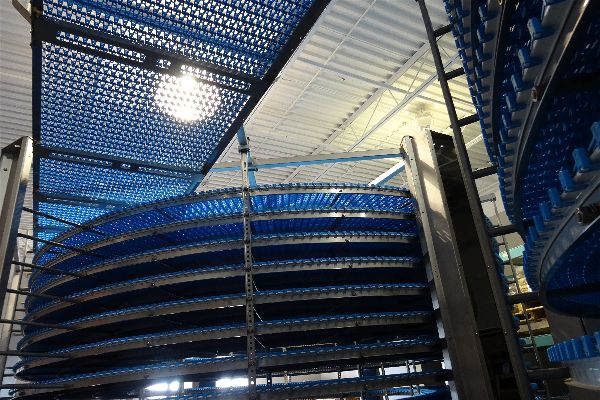
Choosing the right spiral drive technology shapes how well a freezing line performs over years of continuous operation. Two of the most capable options are the Positive Drive spiral and the OutRunner spiral, each built on a different mechanical principle. Understanding the positive drive vs outrunner spiral comparison helps food processors match the equipment to their product, throughput, and plant conditions. This blog breaks down how the two systems differ across the factors that matter most in sub-zero freezing applications.
Drive Mechanisms Behind Each Spiral Type
The core difference lies in how each system moves the belt. A Positive Drive spiral uses a stainless-steel grid belt with driving tabs on the inside edge that engage vertical ribs on the center drum. The belt behaves like a timing gear, so it advances smoothly with no pulse or stutter and the product stays firmly in rows through the spiral.
The OutRunner spiral works the opposite way. Rather than driving from the center, it uses a vertical line shaft on the outside, with sprockets at each tier turning the outer edge of the chain. Sharing the drive across every tier means the central cage is no longer needed, leaving a cleaner, simpler structure. Both designs move product reliably, but where the drive sits gives each its own character.
Belt Tension and Load Distribution Differences
Belt tension affects reliability, wear, and product handling across a long freezing run. The Positive Drive system spreads load evenly along the entire belt path, so overall tension runs roughly 50 percent lower than a conventional slip drive. This lower tension reduces stress on the belt and supports heavier product loads without strain.
Load distribution on the OutRunner follows a different logic. With each tier driven at its outer edge, the tiers carry the work together instead of depending on a single cage. That shared effort is efficient enough that one large tandem dual spiral can run on a single 2 HP drive motor. Both systems handle tension well, with the Positive Drive spreading it evenly along one belt and the OutRunner dividing it across tiers.
Handling Sensitive and Delicate Frozen Products
Delicate frozen items such as coated snacks, portioned proteins, and novelties need gentle, consistent movement. The Positive Drive system keeps products firmly in rows with steady, pulse-free motion, which protects items that shift or damage easily. This makes it a strong fit for products that must hold their position and shape through the full freeze.
On delicate lines, the OutRunner offers a different kind of advantage. It reverses fully for accumulating applications and gives real flexibility in loads, speeds, and incline angles, which suits lines where product mix or flow shifts often. For the most demanding items, a tandem OutRunner layout can crust-freeze the surface in the first unit before the second freezes the core.
Maintenance Demands in Sub-Zero Conditions
Cold, continuous operation puts real demands on any freezing system. The Positive Drive spiral needs very little maintenance, and up-running spirals require only a single cage motor and variable frequency drive. Its self-synchronizing action keeps the belt running smoothly, which reduces wear over long shifts in the cold.
The OutRunner keeps maintenance manageable in another way. Its units share components with the standard SpanTech line, so there are fewer spare parts to stock and troubleshooting stays straightforward. In a plant running around the clock, fewer unique parts means service gets done faster. Both systems ease the maintenance burden, one through simplicity of design and the other through shared, familiar components.
Suitability by Product Type and Line Speed
Product type and line speed often decide which spiral fits best. The Positive Drive excels with oily or slippery products that cause tracking problems on friction-driven belts, and it handles heavier loads in a compact footprint. Lines running dense, high-load products tend to benefit from its even tension and firm product control.
The OutRunner is at home on high-speed, flexible lines. It reaches speeds up to 400 feet per minute while drawing very little power, a combination that keeps fast operations efficient. Both technologies feature in CONOVEY’s range of spiral conveyors built for freezing and cooling duties.
Selecting the Configuration for Your Freezing Goals
The positive drive vs outrunner spiral decision comes down to matching the drive to your specific line. A Positive Drive spiral rewards lines with heavy, oily, or delicate products that need firm, even handling and minimal maintenance. An OutRunner rewards lines that value high speed, low power draw, flexible configuration, and shared spare parts.
Neither system is simply better than the other. The right choice depends on your product, throughput targets, plant layout, and how the line is expected to grow. A manufacturer that builds across both technologies can weigh these factors honestly and recommend the configuration that fits, rather than forcing a single design onto every application.
CONOVEY manufactures material handling conveyors for food processors, CPG manufacturers, and robotics integrators across the food & beverage and industrial automation markets. Contact CONOVEY to discuss which spiral drive technology best fits your freezing application and production goals.


- Various Drive Options
- Tapered Rollers also available
- Optional Polyurethane sleeving
- Variable speed is standard
- Safe low voltage & wide range of speeds
- 1201/1202 | Belt Rollers, Single or Double Groove Light/Medium Duty Conveyors Rollers, Custom Made Grooves | ⌀50mm Roller | ⌀11mm, ⌀14mm Shafts
- 1203 | Belt Pulley Rollers, Light/Medium Duty Conveyor Rollers | ⌀50mm Roller | ⌀11mm, ⌀14mm Shafts
- Suitable for wide range of application for Buffer or accumulation require
- Single drive with start/stop application suitable
- Single or double 14 teeth x 1/2” sprockets can be fitted (choice of steel or nylon sprockets)
- Mild steel and stainless steel options
- Stainless steel options available for all fixed driven conveyor rollers
- 1301/1302 | Polymer sprocket rollers, single or double sprocket, low running noise, polyamide bearing housing | 50mm Dia | ⌀14mm Shaft
- 1303/1304 | Steel sprocket, single or double sprocket, polyamide bearing housing | ⌀50mm Roller | ⌀14mm Shafts
- 1305/1306 | Steel sprocket, adjustable torque, single or double sprocket, polyamide/steel bearing housing | ⌀50mm, ⌀60mm, ⌀76 mm Rollers | ⌀14mm, ⌀15mm, ⌀20mm Shafts
- 1201/1202 | belt rollers, single or double groove light/medium duty conveyor rollers, custom made groove | ⌀50mm Roller | ⌀11mm, ⌀14mm Shafts
- 1203 | Belt Pulley Rollers, Light/Medium Duty Conveyor Rollers | ⌀50mm Roller | ⌀11mm, ⌀14mm Shafts
- Single and Double Grooves option
- Light and medium duty driven roller fitter with nylon O ring sprocket
- Line-shaft and 24V DC motorized rollers conveyors
- Mild steel, stainless steel and plastic options
- Stainless steel options available for all fixed driven conveyor rollers
- Free running bearings
- Wide range of tube and shaft options
- Wide range to handle from 100gm to 500kg per roller capacity
- Mild steel, stainless steel and plastic options
- Our most economical price rollers
- 1101 | PVC tube, polyamide bearing housing, light duty conveyor rollers | ⌀25mm, ⌀38mm, ⌀50mm Rollers | ⌀10mm, ⌀12mm Shafts
- 1102 | Light and medium duty universal conveyor rollers, polyamide bearing housing | ⌀25mm, ⌀38mm, ⌀50mm, ⌀76mm, ⌀89mm Rollers | ⌀14mm, ⌀20mm Shafts
- 1103 | Gravity conveyor rollers, steel bearing housing | ⌀50mm, ⌀76mm, ⌀89mm Rollers | ⌀14mm, ⌀20mm Shafts
- 1201/1202 | belt rollers, single or double groove light/medium duty conveyor rollers, custom made groove | ⌀50mm Roller | ⌀11mm, ⌀14mm Shafts
- 1203 | Belt Pulley Rollers, Light/Medium Duty Conveyor Rollers | ⌀50mm Roller | ⌀11mm, ⌀14mm Shafts
- 1204 | Poly V belt pulley rollers, medium duty and high speed conveyor rollers | ⌀50mm Roller | ⌀11mm, ⌀14mm Shafts
- 1205 | Timing belt pulley rollers, medium duty and high speed conveyor rollers | ⌀50mm Roller | ⌀11mm, ⌀14mm Shafts
- 1206/1207 | Polymer sprocket rollers, single or double sprocket, medium duty and low running noise, polyamide bearing housing | ⌀50mm Roller | ⌀14mm Shafts
- 1208/1209 | Steel sprocket, single or double sprocket, medium/heavy duty conveying application, polyamide bearing housing | ⌀50mm, ⌀60mm, ⌀76mm Rollers, ⌀89mm Roller | ⌀14mm, ⌀15mm, ⌀20mm Shafts
- 1210/1211 | Steel sprocket, steel bearing housing, heavy duty conveying, strong and reliable | ⌀50mm, ⌀76mm, ⌀89mm Rollers | ⌀14mm, ⌀15mm, ⌀20mm Shafts
- Free running option for gravity roller conveyors.
- All tapered conveyor rollers have a sealed bearing option for wash-down areas
- 50mm diameter base roller can be grooved for line-shaft conveyors
- Tapered sleeve rollers to suits an inside radius of 500mm to 1200mm
- Single or double 14 teeth x 1/2” sprockets can be fitted (choice of steel or nylon sprockets)
- Mild steel and stainless steel options
- Stainless steel options available for all fixed driven conveyor rollers
- 1401 | Gravity tapered roller, attractive look and low noise | ⌀53mm, ⌀56mm, ⌀50mm Rollers | ⌀12mm, ⌀14mm Shafts
- 1402 | belt drive, Double grooved tapered sleeve roller, customized groove position | ⌀53mm, ⌀56mm, ⌀50mm Rollers | ⌀14mm Shaft
- 1403 | belt pulley drive, Double grooved O belt pulley tapered sleeve roller | ⌀53mm, ⌀56mm, ⌀50mm Rollers | ⌀14mm Shaft
- 1404 | Poly vee belt pulley drive tapered sleeve roller, high speed, low noise | ⌀53mm, ⌀56mm, ⌀50mm Rollers | ⌀14mm Shaft
- 1405 | Polymer sprocket drive tapered sleeve roller, medium duty, low noise | ⌀53mm, ⌀56mm, ⌀50mm Rollers | ⌀14mm Shaft
- Widths | 250mm, 350mm, 450mm, 650mm, 850mm |
- Lengths | 500mm, 1000mm, 1500mm, 2000mm, 2500mm |
- Max Pallet/Carrier Wgt (kg) | 50kg/250kg |
- Pallet Sizes | 238X306, 332X430, 428X550, 522X670 |
- Height Range | 500mm - 1000mm |
- Load Accuracy | +/-0.5mm Stop Unit | +/-0.1mm Locating Pin | +/-.05mm Lift & Locate |
- Roller Pitch | 82.5mm, 127mm, 150.8mm |
- Roller ⌀ | 50mm, 76mm |
- Max Length per Drive | 7500mm |
- Drive Motor Size | .5HP, 1HP | SEW |
- Drive Speeds | 2-24 mpm
- Frame Materials | Aluminum or Powder Coat Mild Steel
- High energy efficiency level with different load application
- Safe, affordable operation without the need for guarding
- Tight positioning tolerances thanks to high precision guide rails
- Active braking and lifting of the Pallets
- Unlimited zero pressure accumulation of Pallets
- Flexible speeds from 0.2 to 24m/min between communication points
- Constant 24V auxiliary power available for energy Saving
- Very limited preventative maintenance required
- No track maintenance due to no moving parts in the track
- Very low noise level, less than 60db(A)
- Easy tracking of the Carts/parts throughout the layout
- Highly standardized components
- Significantly reduced wiring and commissioning time
- Low profile for easy part access around the line
- Tip protection for overhanging loads optionally available
- Adaptable pallet length to fit the size of your part