How Spiral Freezer Design Protects the Texture of Quick Frozen Foods

Positive Drive Vs. OutRunner Spirals for Freezing Applications
August 19, 2026
6 Maintenance Practices That Extend Spiral Freezer Belt Life
September 16, 2026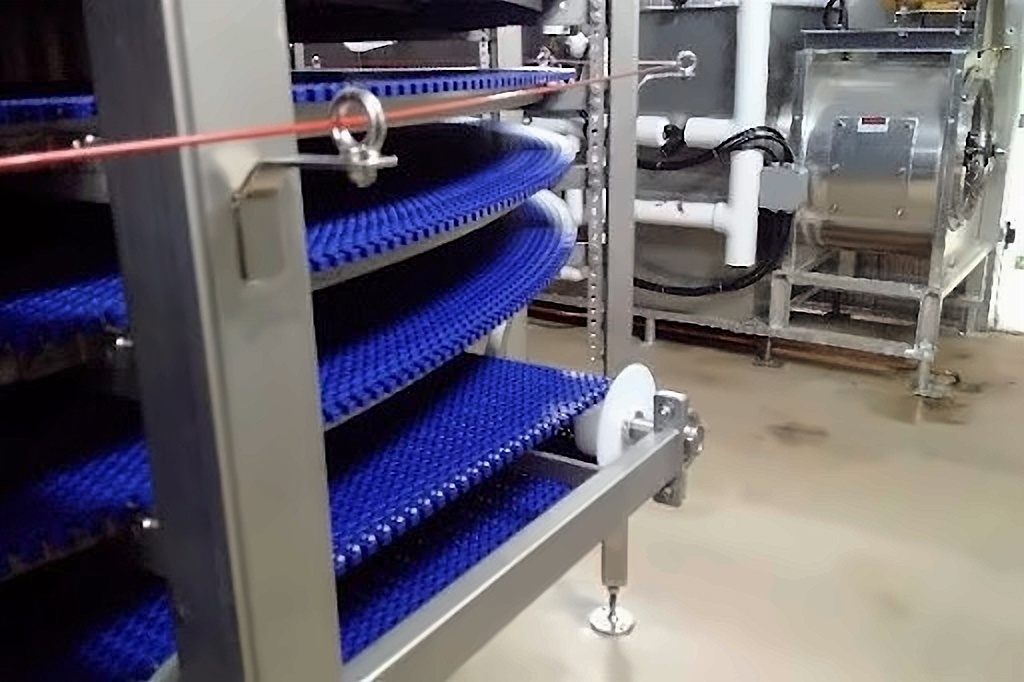
Texture is what a frozen food buyer notices first. A cracker that shatters, a shrimp that turns rubbery, or a berry that weeps on thawing all trace back to how the product froze. The freezer decides whether a line protects the quality it built upstream or gives it away. Design choices around freeze speed, airflow, belt style, and dwell time shape the result, and spiral freezer energy efficiency rides on those same choices. This blog explains how a well-engineered spiral protects the texture of quick frozen foods.
Why Freeze Speed Determines Ice Crystal Size
Freeze speed sets the size of the ice crystals that form inside a product. When product freezes fast, crystals stay small and do less damage to cell walls, so texture holds after thawing. When it freezes slowly, large crystals form and rupture the structure, which leaves a softer, wetter result. Product leaves the process line warm, and every minute before it reaches its target core temperature affects quality, yield, and shelf life. A spiral coils a long belt into a compact footprint, which gives products the extended freezing time they need to hit that core temperature quickly.
Airflow Velocity and Uniform Heat Removal Across Tiers
Airflow is where a spiral freezer earns or loses its performance. Freezing moves heat from the product into the circulating cold air, so the faster and more uniformly that air passes over each item, the sooner the core freezes. Poor airflow leaves warm pockets and uneven results. CONOVEY controls airflow through fan placement, air direction, and how the airstream is guided through the belt stack. The open center of an externally driven spiral improves air movement through the tiers. Uniformity matters as much as velocity, since a product on the belt edge should freeze at the same rate as one in the center.
Belt Selection for Delicate and Free-Flowing Products
Belt style decides how gently a product rides through the freeze. CONOVEY matches belt style to the product and the drive technology, and the choice between a plastic chain and a steel grid belt affects both performance and cleanability. The Positive Drive system uses a stainless steel grid belt with driving tabs that engage vertical ribs on the center drum, so the belt behaves like a timing gear, and product stays firmly in rows. That steady, pulse-free motion protects items that shift or damage easily. For oily or coated products that cause tracking problems on friction-driven belts, positive engagement keeps pieces oriented.
Preventing Clumping During High Volume Runs
Free-flowing frozen products clump when pieces touch before their surfaces set. The answer is a surface freeze that happens quickly and evenly, which comes back to airflow and steady belt movement. The self-synchronizing action of the Positive Drive belt keeps product moving in even rows with no pulse or stutter, so pieces hold their spacing. For very demanding lines, a tandem layout lets the first spiral crust freeze the surface before the second completes the core, which keeps pieces separate at high throughput. Strong spiral freezer energy efficiency supports this, since efficient drives handle high volume without wasted power.
Matching Dwell Time to Product Thickness and Density
Dwell time has to match the product, because capacity depends on how much heat must be removed rather than how many units pass through. A dense, thick portion carries far more heat than a thin, light one, so it needs longer in the cold to reach a safe core temperature. CONOVEY sets belt speed through the drive and control interface, so operators slow the belt for a denser product or speed it up for a lighter line without stopping production. Variable speed operation is standard, letting a plant adapt to a changing product mix while maintaining freeze consistency.
Design Choices That Protect Color, Shape, and Yield
Every design decision covered here works toward the same end: a finished product that looks and performs the way it should. Fast, uniform freezing preserves color and shape, gentle belt handling holds delicate items intact, and matched dwell time prevents both under-freezing and the moisture loss that cuts yield. None of this happens by accident. It comes from careful engineering rather than a fixed design, which is also where strong spiral freezer energy efficiency comes from, since the same efficient drives that lower power consumption also reduce maintenance. Product quality and spiral freezer energy efficiency, in other words, are two results of the same work. This is exactly how spiral freezer manufacturers engineer custom freezing systems, matching every variable to the line the spiral will serve.
The takeaway for any processor is simple: the freezer you choose decides the texture, color, and yield your customers judge you on. CONOVEY sizes belt width, tier count, and airflow around a line’s throughput and available space across its range of spiral conveyors built for freezing and cooling duties. Contact CONOVEY to engineer a spiral freezer that protects the texture, color, and yield of your quick frozen foods.


- Various Drive Options
- Tapered Rollers also available
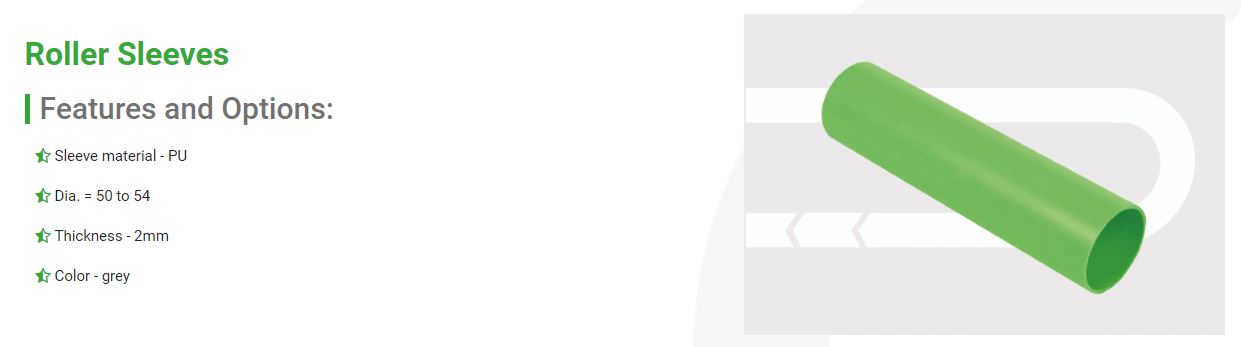
- Optional Polyurethane sleeving
- Variable speed is standard
- Safe low voltage & wide range of speeds
- 1201/1202 | Belt Rollers, Single or Double Groove Light/Medium Duty Conveyors Rollers, Custom Made Grooves | ⌀50mm Roller | ⌀11mm, ⌀14mm Shafts
- 1203 | Belt Pulley Rollers, Light/Medium Duty Conveyor Rollers | ⌀50mm Roller | ⌀11mm, ⌀14mm Shafts
- Suitable for wide range of application for Buffer or accumulation require
- Single drive with start/stop application suitable
- Single or double 14 teeth x 1/2” sprockets can be fitted (choice of steel or nylon sprockets)
- Mild steel and stainless steel options
- Stainless steel options available for all fixed driven conveyor rollers
- 1301/1302 | Polymer sprocket rollers, single or double sprocket, low running noise, polyamide bearing housing | 50mm Dia | ⌀14mm Shaft
- 1303/1304 | Steel sprocket, single or double sprocket, polyamide bearing housing | ⌀50mm Roller | ⌀14mm Shafts
- 1305/1306 | Steel sprocket, adjustable torque, single or double sprocket, polyamide/steel bearing housing | ⌀50mm, ⌀60mm, ⌀76 mm Rollers | ⌀14mm, ⌀15mm, ⌀20mm Shafts
- 1201/1202 | belt rollers, single or double groove light/medium duty conveyor rollers, custom made groove | ⌀50mm Roller | ⌀11mm, ⌀14mm Shafts
- 1203 | Belt Pulley Rollers, Light/Medium Duty Conveyor Rollers | ⌀50mm Roller | ⌀11mm, ⌀14mm Shafts
- Single and Double Grooves option
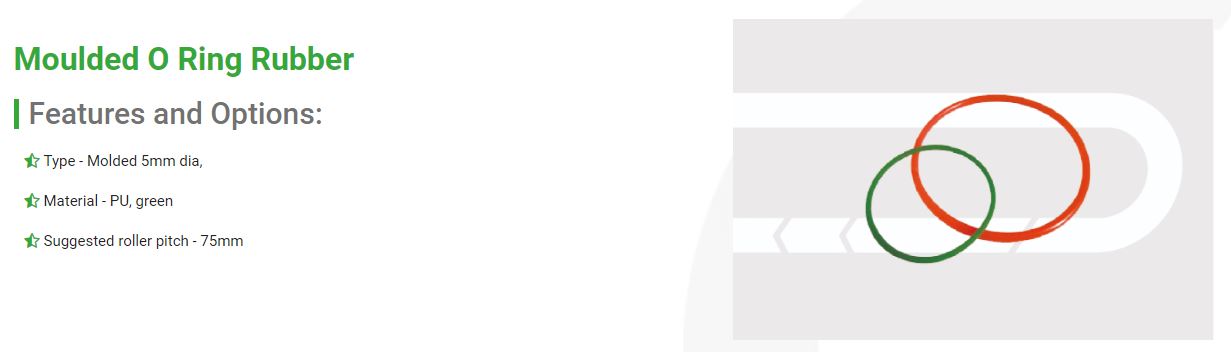
- Light and medium duty driven roller fitter with nylon O ring sprocket
- Line-shaft and 24V DC motorized rollers conveyors
- Mild steel, stainless steel and plastic options
- Stainless steel options available for all fixed driven conveyor rollers
- Free running bearings
- Wide range of tube and shaft options
- Wide range to handle from 100gm to 500kg per roller capacity
- Mild steel, stainless steel and plastic options
- Our most economical price rollers
- 1101 | PVC tube, polyamide bearing housing, light duty conveyor rollers | ⌀25mm, ⌀38mm, ⌀50mm Rollers | ⌀10mm, ⌀12mm Shafts
- 1102 | Light and medium duty universal conveyor rollers, polyamide bearing housing | ⌀25mm, ⌀38mm, ⌀50mm, ⌀76mm, ⌀89mm Rollers | ⌀14mm, ⌀20mm Shafts
- 1103 | Gravity conveyor rollers, steel bearing housing | ⌀50mm, ⌀76mm, ⌀89mm Rollers | ⌀14mm, ⌀20mm Shafts
- 1201/1202 | belt rollers, single or double groove light/medium duty conveyor rollers, custom made groove | ⌀50mm Roller | ⌀11mm, ⌀14mm Shafts
- 1203 | Belt Pulley Rollers, Light/Medium Duty Conveyor Rollers | ⌀50mm Roller | ⌀11mm, ⌀14mm Shafts
- 1204 | Poly V belt pulley rollers, medium duty and high speed conveyor rollers | ⌀50mm Roller | ⌀11mm, ⌀14mm Shafts
- 1205 | Timing belt pulley rollers, medium duty and high speed conveyor rollers | ⌀50mm Roller | ⌀11mm, ⌀14mm Shafts
- 1206/1207 | Polymer sprocket rollers, single or double sprocket, medium duty and low running noise, polyamide bearing housing | ⌀50mm Roller | ⌀14mm Shafts
- 1208/1209 | Steel sprocket, single or double sprocket, medium/heavy duty conveying application, polyamide bearing housing | ⌀50mm, ⌀60mm, ⌀76mm Rollers, ⌀89mm Roller | ⌀14mm, ⌀15mm, ⌀20mm Shafts
- 1210/1211 | Steel sprocket, steel bearing housing, heavy duty conveying, strong and reliable | ⌀50mm, ⌀76mm, ⌀89mm Rollers | ⌀14mm, ⌀15mm, ⌀20mm Shafts
- Free running option for gravity roller conveyors.
- All tapered conveyor rollers have a sealed bearing option for wash-down areas
- 50mm diameter base roller can be grooved for line-shaft conveyors
- Tapered sleeve rollers to suits an inside radius of 500mm to 1200mm
- Single or double 14 teeth x 1/2” sprockets can be fitted (choice of steel or nylon sprockets)
- Mild steel and stainless steel options
- Stainless steel options available for all fixed driven conveyor rollers
- 1401 | Gravity tapered roller, attractive look and low noise | ⌀53mm, ⌀56mm, ⌀50mm Rollers | ⌀12mm, ⌀14mm Shafts
- 1402 | belt drive, Double grooved tapered sleeve roller, customized groove position | ⌀53mm, ⌀56mm, ⌀50mm Rollers | ⌀14mm Shaft
- 1403 | belt pulley drive, Double grooved O belt pulley tapered sleeve roller | ⌀53mm, ⌀56mm, ⌀50mm Rollers | ⌀14mm Shaft
- 1404 | Poly vee belt pulley drive tapered sleeve roller, high speed, low noise | ⌀53mm, ⌀56mm, ⌀50mm Rollers | ⌀14mm Shaft
- 1405 | Polymer sprocket drive tapered sleeve roller, medium duty, low noise | ⌀53mm, ⌀56mm, ⌀50mm Rollers | ⌀14mm Shaft
- Widths | 250mm, 350mm, 450mm, 650mm, 850mm |
- Lengths | 500mm, 1000mm, 1500mm, 2000mm, 2500mm |
- Max Pallet/Carrier Wgt (kg) | 50kg/250kg |
- Pallet Sizes | 238X306, 332X430, 428X550, 522X670 |
- Height Range | 500mm - 1000mm |
- Load Accuracy | +/-0.5mm Stop Unit | +/-0.1mm Locating Pin | +/-.05mm Lift & Locate |
- Roller Pitch | 82.5mm, 127mm, 150.8mm |
- Roller ⌀ | 50mm, 76mm |
- Max Length per Drive | 7500mm |
- Drive Motor Size | .5HP, 1HP | SEW |
- Drive Speeds | 2-24 mpm
- Frame Materials | Aluminum or Powder Coat Mild Steel
- High energy efficiency level with different load application
- Safe, affordable operation without the need for guarding
- Tight positioning tolerances thanks to high precision guide rails
- Active braking and lifting of the Pallets
- Unlimited zero pressure accumulation of Pallets
- Flexible speeds from 0.2 to 24m/min between communication points
- Constant 24V auxiliary power available for energy Saving
- Very limited preventative maintenance required
- No track maintenance due to no moving parts in the track
- Very low noise level, less than 60db(A)
- Easy tracking of the Carts/parts throughout the layout
- Highly standardized components
- Significantly reduced wiring and commissioning time
- Low profile for easy part access around the line
- Tip protection for overhanging loads optionally available
- Adaptable pallet length to fit the size of your part