Flat Belt Conveyor vs. Retractable Conveyor: Which Delivers Better Throughput?

Applications of Spiral Conveyors in the Bakery and Frozen Food Industries
December 3, 2025
How Sanitary Food Packaging Conveyors Prevent Cross-Contamination
December 5, 2025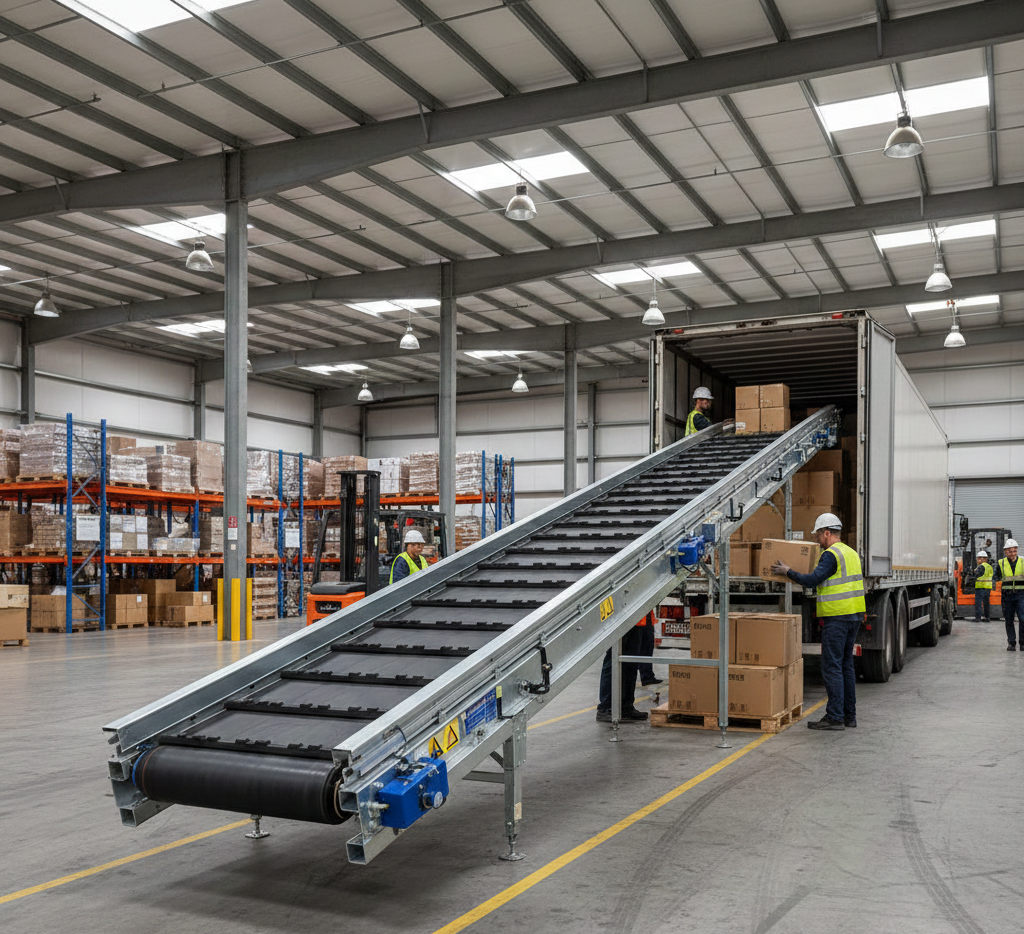
Production efficiency often depends on how smoothly products transition from one stage to another. Conveyor choice plays a major role here, especially when operations handle high volumes or require frequent access points along the line. Systems such as the retractable conveyor and the flat belt design each offer unique advantages, and the right choice can dramatically impact throughput, workflow, and operational speed.
Many facilities rely on either solution, or a combination of both, to optimize movement, reduce stoppages, and simplify manual interventions. Understanding how these conveyors perform under real production conditions is essential for selecting the best fit for throughput goals.
Understanding Flat Belt Conveyors: Simplicity Meets Consistency
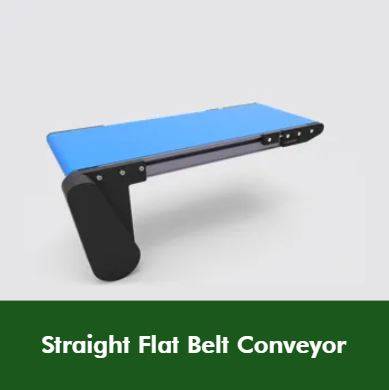
A flat belt conveyor is one of the most widely used material-handling systems due to its streamlined design and reliable movement. These conveyors transport products over a continuous flat belt made from rubber, PVC, urethane, or modular materials. Their straightforward structure delivers consistent speed, smooth product handling, and minimal vibration, making them ideal for packaging, inspection, fresh produce handling, automotive components, and light assembly.
Flat belt systems also support high-speed applications, allowing products to travel efficiently between stations without interruptions or misalignment. Their dependable transport solutions are one reason they remain a standard across the food, logistics, and manufacturing sectors.
Retractable Conveyors: Built for Flexibility and Smart Line Design
A retractable conveyor extends and retracts to create openings within the production line. This design provides flexible access for workers, equipment, or manual tasks such as cleaning, inspections, or product removal. Some retractable systems operate manually, while others use automation, sensors, or pneumatic motion for seamless integration into broader production workflows.
Industries that require frequent tool changeouts, quality checks, or multi-directional product flow often benefit most from retractable systems. Their ability to temporarily bridge or withdraw from the line makes them essential to smart, ergonomic layouts.
Comparing Throughput: Flat Belt vs. Retractable Conveyor Systems
Throughput depends not only on conveyor speed but also on the system’s ability to keep the line moving without unnecessary pauses. Flat belt conveyors excel here because they maintain continuous operation with low variability. Their simple path and uninterrupted transport reduce the risks of delays.
Retractable conveyors, however, excel in environments where controlled pauses enhance throughput rather than hinder it. The ability to open the line for manual tasks eliminates the need for complete system shutdowns. When integrated with ARB Conveyors or other automated routing systems, retractable designs help improve product sorting, merging, and distribution efficiency.
Ultimately, flat belt conveyors lead in continuous throughput, while retractable systems support operational flexibility that prevents downstream delays.
Customization and Integration Options
Both conveyor types can be tailored to specific industry needs. Facilities often combine custom built conveyors with retractable sections, turning complex layouts into streamlined production cells. Integrations may include sensors, washdown components, product guides, belt lift mechanisms, and automated transfer modules.
ARB (Activated Roller Belt) technology also complements both systems by enabling sorting, diverting, and aligning without manual handling. When paired correctly, these systems can significantly increase line efficiency and reduce labour time.
Maintenance and Operational Considerations
Flat belt conveyors are known for low maintenance. Their simple drive system and fewer moving parts make cleaning and belt replacement straightforward. They are especially suitable for food production lines that require daily sanitation.
Retractable conveyors include mechanical or automated retraction components that require routine checks for alignment, wear, and smooth operation. Proper maintenance ensures the retraction mechanism operates without hesitation, protecting throughput and system longevity.
Safety, Space, and Ergonomic Advantages
Retractable conveyors offer major ergonomic benefits by providing safe access without dismantling equipment. Workers can step into the line for cleaning or adjustments without having to climb over or reach under the conveyor. This improves facility safety and reduces injury risks.
Flat belt conveyors provide strong spatial efficiency in straight-line movement but cannot create access points unless combined with additional components.
Cost vs. ROI: Which Conveyor Type Offers Better Long-Term Value?
Flat belt conveyors typically cost less upfront and deliver strong long-term ROI through durability and ease of maintenance. For operations focused on high-volume, uninterrupted flow, they provide exceptional value.
Retractable conveyors, while more specialized, deliver ROI by reducing downtime during inspections, sanitation, and manual interventions. Their ability to improve ergonomic workflow can also reduce labour-related fatigue and inefficiencies.
Real-World Use Cases Across Industries
- Food processing: Flat belts for inspection and packaging; retractable units for allergen checks or sanitation access.
- Logistics and e-commerce: Flat belts for high-speed parcel handling; retractable systems for routing and diverting.
- Manufacturing: Flat belts for assembly; retractable designs for tool changes and quality checks.
- Beverage and bottling: Integrations with ARB Conveyors for high-efficiency sorting and merging.
Choosing the Right Conveyor for Maximum Throughput
Both conveyor types offer distinct advantages. The retractable conveyor promotes flexibility and ergonomic efficiency, while the flat belt conveyor excels in continuous, high-speed throughput. Many facilities benefit from a hybrid approach using tailored, custom-built conveyors engineered by trusted partners. Conovey combines precision engineering with industry-focused solutions to enhance flow efficiency and production speed.
Contact Conovey today to learn more about custom conveyor systems designed to maximize throughput and support long-term operational performance.


- Various Drive Options
- Tapered Rollers also available
- Optional Polyurethane sleeving
- Variable speed is standard
- Safe low voltage & wide range of speeds
- 1201/1202 | Belt Rollers, Single or Double Groove Light/Medium Duty Conveyors Rollers, Custom Made Grooves | ⌀50mm Roller | ⌀11mm, ⌀14mm Shafts
- 1203 | Belt Pulley Rollers, Light/Medium Duty Conveyor Rollers | ⌀50mm Roller | ⌀11mm, ⌀14mm Shafts
- Suitable for wide range of application for Buffer or accumulation require
- Single drive with start/stop application suitable
- Single or double 14 teeth x 1/2” sprockets can be fitted (choice of steel or nylon sprockets)
- Mild steel and stainless steel options
- Stainless steel options available for all fixed driven conveyor rollers
- 1301/1302 | Polymer sprocket rollers, single or double sprocket, low running noise, polyamide bearing housing | 50mm Dia | ⌀14mm Shaft
- 1303/1304 | Steel sprocket, single or double sprocket, polyamide bearing housing | ⌀50mm Roller | ⌀14mm Shafts
- 1305/1306 | Steel sprocket, adjustable torque, single or double sprocket, polyamide/steel bearing housing | ⌀50mm, ⌀60mm, ⌀76 mm Rollers | ⌀14mm, ⌀15mm, ⌀20mm Shafts
- 1201/1202 | belt rollers, single or double groove light/medium duty conveyor rollers, custom made groove | ⌀50mm Roller | ⌀11mm, ⌀14mm Shafts
- 1203 | Belt Pulley Rollers, Light/Medium Duty Conveyor Rollers | ⌀50mm Roller | ⌀11mm, ⌀14mm Shafts
- Single and Double Grooves option
- Light and medium duty driven roller fitter with nylon O ring sprocket
- Line-shaft and 24V DC motorized rollers conveyors
- Mild steel, stainless steel and plastic options
- Stainless steel options available for all fixed driven conveyor rollers
- Free running bearings
- Wide range of tube and shaft options
- Wide range to handle from 100gm to 500kg per roller capacity
- Mild steel, stainless steel and plastic options
- Our most economical price rollers
- 1101 | PVC tube, polyamide bearing housing, light duty conveyor rollers | ⌀25mm, ⌀38mm, ⌀50mm Rollers | ⌀10mm, ⌀12mm Shafts
- 1102 | Light and medium duty universal conveyor rollers, polyamide bearing housing | ⌀25mm, ⌀38mm, ⌀50mm, ⌀76mm, ⌀89mm Rollers | ⌀14mm, ⌀20mm Shafts
- 1103 | Gravity conveyor rollers, steel bearing housing | ⌀50mm, ⌀76mm, ⌀89mm Rollers | ⌀14mm, ⌀20mm Shafts
- 1201/1202 | belt rollers, single or double groove light/medium duty conveyor rollers, custom made groove | ⌀50mm Roller | ⌀11mm, ⌀14mm Shafts
- 1203 | Belt Pulley Rollers, Light/Medium Duty Conveyor Rollers | ⌀50mm Roller | ⌀11mm, ⌀14mm Shafts
- 1204 | Poly V belt pulley rollers, medium duty and high speed conveyor rollers | ⌀50mm Roller | ⌀11mm, ⌀14mm Shafts
- 1205 | Timing belt pulley rollers, medium duty and high speed conveyor rollers | ⌀50mm Roller | ⌀11mm, ⌀14mm Shafts
- 1206/1207 | Polymer sprocket rollers, single or double sprocket, medium duty and low running noise, polyamide bearing housing | ⌀50mm Roller | ⌀14mm Shafts
- 1208/1209 | Steel sprocket, single or double sprocket, medium/heavy duty conveying application, polyamide bearing housing | ⌀50mm, ⌀60mm, ⌀76mm Rollers, ⌀89mm Roller | ⌀14mm, ⌀15mm, ⌀20mm Shafts
- 1210/1211 | Steel sprocket, steel bearing housing, heavy duty conveying, strong and reliable | ⌀50mm, ⌀76mm, ⌀89mm Rollers | ⌀14mm, ⌀15mm, ⌀20mm Shafts
- Free running option for gravity roller conveyors.
- All tapered conveyor rollers have a sealed bearing option for wash-down areas
- 50mm diameter base roller can be grooved for line-shaft conveyors
- Tapered sleeve rollers to suits an inside radius of 500mm to 1200mm
- Single or double 14 teeth x 1/2” sprockets can be fitted (choice of steel or nylon sprockets)
- Mild steel and stainless steel options
- Stainless steel options available for all fixed driven conveyor rollers
- 1401 | Gravity tapered roller, attractive look and low noise | ⌀53mm, ⌀56mm, ⌀50mm Rollers | ⌀12mm, ⌀14mm Shafts
- 1402 | belt drive, Double grooved tapered sleeve roller, customized groove position | ⌀53mm, ⌀56mm, ⌀50mm Rollers | ⌀14mm Shaft
- 1403 | belt pulley drive, Double grooved O belt pulley tapered sleeve roller | ⌀53mm, ⌀56mm, ⌀50mm Rollers | ⌀14mm Shaft
- 1404 | Poly vee belt pulley drive tapered sleeve roller, high speed, low noise | ⌀53mm, ⌀56mm, ⌀50mm Rollers | ⌀14mm Shaft
- 1405 | Polymer sprocket drive tapered sleeve roller, medium duty, low noise | ⌀53mm, ⌀56mm, ⌀50mm Rollers | ⌀14mm Shaft
- Widths | 250mm, 350mm, 450mm, 650mm, 850mm |
- Lengths | 500mm, 1000mm, 1500mm, 2000mm, 2500mm |
- Max Pallet/Carrier Wgt (kg) | 50kg/250kg |
- Pallet Sizes | 238X306, 332X430, 428X550, 522X670 |
- Height Range | 500mm - 1000mm |
- Load Accuracy | +/-0.5mm Stop Unit | +/-0.1mm Locating Pin | +/-.05mm Lift & Locate |
- Roller Pitch | 82.5mm, 127mm, 150.8mm |
- Roller ⌀ | 50mm, 76mm |
- Max Length per Drive | 7500mm |
- Drive Motor Size | .5HP, 1HP | SEW |
- Drive Speeds | 2-24 mpm
- Frame Materials | Aluminum or Powder Coat Mild Steel
- High energy efficiency level with different load application
- Safe, affordable operation without the need for guarding
- Tight positioning tolerances thanks to high precision guide rails
- Active braking and lifting of the Pallets
- Unlimited zero pressure accumulation of Pallets
- Flexible speeds from 0.2 to 24m/min between communication points
- Constant 24V auxiliary power available for energy Saving
- Very limited preventative maintenance required
- No track maintenance due to no moving parts in the track
- Very low noise level, less than 60db(A)
- Easy tracking of the Carts/parts throughout the layout
- Highly standardized components
- Significantly reduced wiring and commissioning time
- Low profile for easy part access around the line
- Tip protection for overhanging loads optionally available
- Adaptable pallet length to fit the size of your part