What to Look for When Sourcing Automation-Ready Conveyor Systems From the Best Conveyor System Manufacturers for Industrial Uses

How Food Processors in Ontario Evaluate Local Suppliers for Custom Conveyors Built to Reduce Cleaning Downtime
June 16, 2026
How Conveyor Clutch Systems Improve Precision and Reliability in Index Conveyor Applications
June 18, 2026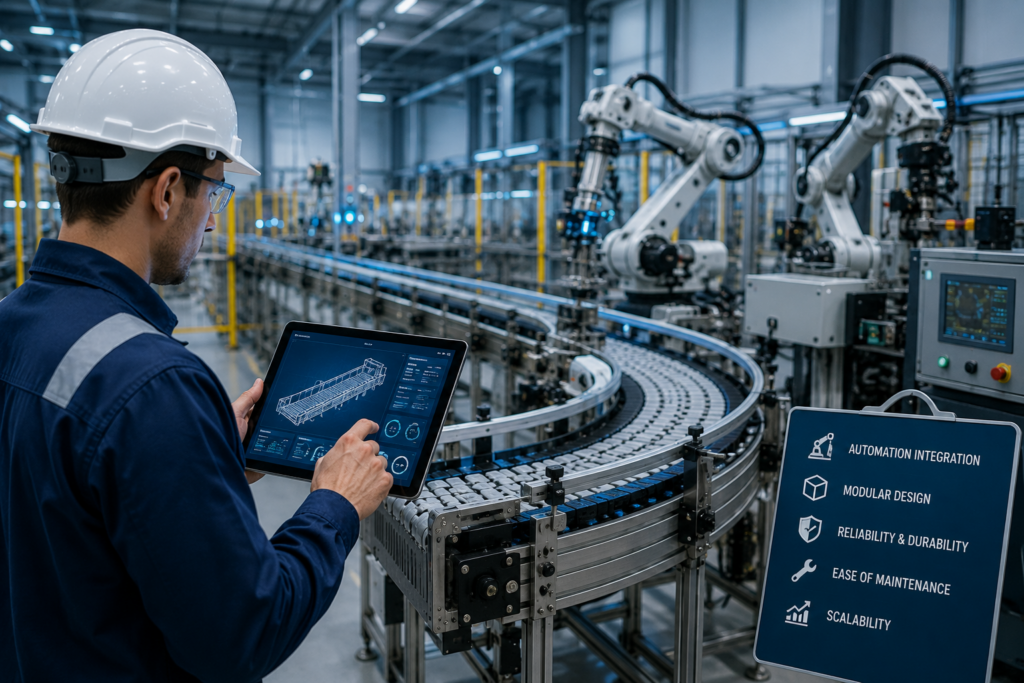
Selecting automation-ready material-handling equipment requires rigorous technical scrutiny across the mechanical, electrical, and software domains. The best conveyor system manufacturers for industrial uses build platforms that integrate seamlessly with existing production lines, motion controllers, and warehouse execution systems. Plant engineers should prioritize partners who demonstrate transparent engineering practices and modular design philosophies.
CONOVEY supports procurement teams evaluating packaging line conveyors and thermal processing solutions through transparent specification processes, prototype validation, and long-term service planning. Sourcing decisions influence uptime, throughput, and capital efficiency throughout the equipment lifecycle.
Choosing an underqualified supplier introduces hidden retrofit costs, integration delays, and avoidable safety risks. Organizations should treat the selection process as a structured engineering review rather than a routine purchasing exercise, with clear acceptance criteria established before supplier quotations are reviewed.
Why Food Packaging Businesses Choose the Best Conveyor System Manufacturers for Industrial Uses
Food packaging operations impose conditions that test every aspect of automated conveyors. Sanitary stainless steel construction, smooth weld profiles, and tool-free disassembly help protect against bacterial harborage during high-frequency washdown cycles. Drainage geometry, sealed bearings, and food-grade belting must withstand caustic cleaning chemistries without premature degradation.
The best conveyor system manufacturers for industrial use design packaging-line conveyors that meet throughput objectives through high-speed switching, accumulation, and indexing while protecting product integrity during transfers. CONOVEY engineers consider inspection integration early in the design process, supporting metal detection, checkweighing, and vision rejection systems within a unified motion strategy.
Regulatory requirements surrounding traceability and allergen control reward designs that simplify sanitation audits and cleaning validation procedures. Choosing an inadequate hygienic platform can increase the risk of recall, contribute to line stoppages, and create costly corrective modifications that far exceed the original equipment investment.
Evaluating Vertical Integration Among the Best Conveyor System Manufacturers
Vertical integration directly affects lead times, quality consistency, and engineering responsiveness. Manufacturers that maintain in-house design, fabrication, controls development, and prototyping capabilities often shorten the path from concept to commissioning. Direct control over machining, welding, and assembly processes helps ensure predictable mechanical performance across complex packaging-line conveyors and automated systems.
When suppliers outsource critical subassemblies, engineering changes and schedule adjustments may become dependent on external vendors, increasing project uncertainty. CONOVEY combines mechanical engineering, automation programming, fabrication, and field service under a unified operational structure, helping reduce handoff challenges during deployment and commissioning.
After-sales support is another important component of vertical integration. Rapid access to replacement parts, retained knowledge of the original design, and direct technician support can help reduce unplanned downtime. Procurement teams should request documentation outlining in-house capabilities, including weld inspection procedures, controls, testing resources, quality assurance processes, and serviceability standards.
Assessing Control Systems From the Best Conveyor System Manufacturers
Control architecture determines whether a conveyor system can scale with future automation investments or become a constraint on operational growth. Modern logic controllers must coordinate variable-frequency drives, servo indexing systems, smart sensors, and upstream or downstream robotics with consistent timing across all operating zones.
The best conveyor system manufacturers for industrial use provide open communication protocols, standardized tag-naming structures, and documented function blocks that integration teams can extend without proprietary restrictions. Modular platforms also simplify integration with autonomous mobile robots, palletizing systems, warehouse management software, and future automation upgrades.
CONOVEY engineers specify control panels and HMI layouts that align with plant standards, supporting efficient commissioning and operator training. Cybersecurity considerations, network segmentation strategies, and remote diagnostic capabilities should be incorporated into the initial specification process rather than addressed after installation. Buyers evaluating automated conveyors should request a tailored quote that clearly outlines controller selection, safety circuit architecture, communication protocols, and long-term connectivity plans before final approval. Contact us now!


- Various Drive Options
- Tapered Rollers also available
- Optional Polyurethane sleeving
- Variable speed is standard
- Safe low voltage & wide range of speeds
- 1201/1202 | Belt Rollers, Single or Double Groove Light/Medium Duty Conveyors Rollers, Custom Made Grooves | ⌀50mm Roller | ⌀11mm, ⌀14mm Shafts
- 1203 | Belt Pulley Rollers, Light/Medium Duty Conveyor Rollers | ⌀50mm Roller | ⌀11mm, ⌀14mm Shafts
- Suitable for wide range of application for Buffer or accumulation require
- Single drive with start/stop application suitable
- Single or double 14 teeth x 1/2” sprockets can be fitted (choice of steel or nylon sprockets)
- Mild steel and stainless steel options
- Stainless steel options available for all fixed driven conveyor rollers
- 1301/1302 | Polymer sprocket rollers, single or double sprocket, low running noise, polyamide bearing housing | 50mm Dia | ⌀14mm Shaft
- 1303/1304 | Steel sprocket, single or double sprocket, polyamide bearing housing | ⌀50mm Roller | ⌀14mm Shafts
- 1305/1306 | Steel sprocket, adjustable torque, single or double sprocket, polyamide/steel bearing housing | ⌀50mm, ⌀60mm, ⌀76 mm Rollers | ⌀14mm, ⌀15mm, ⌀20mm Shafts
- 1201/1202 | belt rollers, single or double groove light/medium duty conveyor rollers, custom made groove | ⌀50mm Roller | ⌀11mm, ⌀14mm Shafts
- 1203 | Belt Pulley Rollers, Light/Medium Duty Conveyor Rollers | ⌀50mm Roller | ⌀11mm, ⌀14mm Shafts
- Single and Double Grooves option
- Light and medium duty driven roller fitter with nylon O ring sprocket
- Line-shaft and 24V DC motorized rollers conveyors
- Mild steel, stainless steel and plastic options
- Stainless steel options available for all fixed driven conveyor rollers
- Free running bearings
- Wide range of tube and shaft options
- Wide range to handle from 100gm to 500kg per roller capacity
- Mild steel, stainless steel and plastic options
- Our most economical price rollers
- 1101 | PVC tube, polyamide bearing housing, light duty conveyor rollers | ⌀25mm, ⌀38mm, ⌀50mm Rollers | ⌀10mm, ⌀12mm Shafts
- 1102 | Light and medium duty universal conveyor rollers, polyamide bearing housing | ⌀25mm, ⌀38mm, ⌀50mm, ⌀76mm, ⌀89mm Rollers | ⌀14mm, ⌀20mm Shafts
- 1103 | Gravity conveyor rollers, steel bearing housing | ⌀50mm, ⌀76mm, ⌀89mm Rollers | ⌀14mm, ⌀20mm Shafts
- 1201/1202 | belt rollers, single or double groove light/medium duty conveyor rollers, custom made groove | ⌀50mm Roller | ⌀11mm, ⌀14mm Shafts
- 1203 | Belt Pulley Rollers, Light/Medium Duty Conveyor Rollers | ⌀50mm Roller | ⌀11mm, ⌀14mm Shafts
- 1204 | Poly V belt pulley rollers, medium duty and high speed conveyor rollers | ⌀50mm Roller | ⌀11mm, ⌀14mm Shafts
- 1205 | Timing belt pulley rollers, medium duty and high speed conveyor rollers | ⌀50mm Roller | ⌀11mm, ⌀14mm Shafts
- 1206/1207 | Polymer sprocket rollers, single or double sprocket, medium duty and low running noise, polyamide bearing housing | ⌀50mm Roller | ⌀14mm Shafts
- 1208/1209 | Steel sprocket, single or double sprocket, medium/heavy duty conveying application, polyamide bearing housing | ⌀50mm, ⌀60mm, ⌀76mm Rollers, ⌀89mm Roller | ⌀14mm, ⌀15mm, ⌀20mm Shafts
- 1210/1211 | Steel sprocket, steel bearing housing, heavy duty conveying, strong and reliable | ⌀50mm, ⌀76mm, ⌀89mm Rollers | ⌀14mm, ⌀15mm, ⌀20mm Shafts
- Free running option for gravity roller conveyors.
- All tapered conveyor rollers have a sealed bearing option for wash-down areas
- 50mm diameter base roller can be grooved for line-shaft conveyors
- Tapered sleeve rollers to suits an inside radius of 500mm to 1200mm
- Single or double 14 teeth x 1/2” sprockets can be fitted (choice of steel or nylon sprockets)
- Mild steel and stainless steel options
- Stainless steel options available for all fixed driven conveyor rollers
- 1401 | Gravity tapered roller, attractive look and low noise | ⌀53mm, ⌀56mm, ⌀50mm Rollers | ⌀12mm, ⌀14mm Shafts
- 1402 | belt drive, Double grooved tapered sleeve roller, customized groove position | ⌀53mm, ⌀56mm, ⌀50mm Rollers | ⌀14mm Shaft
- 1403 | belt pulley drive, Double grooved O belt pulley tapered sleeve roller | ⌀53mm, ⌀56mm, ⌀50mm Rollers | ⌀14mm Shaft
- 1404 | Poly vee belt pulley drive tapered sleeve roller, high speed, low noise | ⌀53mm, ⌀56mm, ⌀50mm Rollers | ⌀14mm Shaft
- 1405 | Polymer sprocket drive tapered sleeve roller, medium duty, low noise | ⌀53mm, ⌀56mm, ⌀50mm Rollers | ⌀14mm Shaft
- Widths | 250mm, 350mm, 450mm, 650mm, 850mm |
- Lengths | 500mm, 1000mm, 1500mm, 2000mm, 2500mm |
- Max Pallet/Carrier Wgt (kg) | 50kg/250kg |
- Pallet Sizes | 238X306, 332X430, 428X550, 522X670 |
- Height Range | 500mm - 1000mm |
- Load Accuracy | +/-0.5mm Stop Unit | +/-0.1mm Locating Pin | +/-.05mm Lift & Locate |
- Roller Pitch | 82.5mm, 127mm, 150.8mm |
- Roller ⌀ | 50mm, 76mm |
- Max Length per Drive | 7500mm |
- Drive Motor Size | .5HP, 1HP | SEW |
- Drive Speeds | 2-24 mpm
- Frame Materials | Aluminum or Powder Coat Mild Steel
- High energy efficiency level with different load application
- Safe, affordable operation without the need for guarding
- Tight positioning tolerances thanks to high precision guide rails
- Active braking and lifting of the Pallets
- Unlimited zero pressure accumulation of Pallets
- Flexible speeds from 0.2 to 24m/min between communication points
- Constant 24V auxiliary power available for energy Saving
- Very limited preventative maintenance required
- No track maintenance due to no moving parts in the track
- Very low noise level, less than 60db(A)
- Easy tracking of the Carts/parts throughout the layout
- Highly standardized components
- Significantly reduced wiring and commissioning time
- Low profile for easy part access around the line
- Tip protection for overhanging loads optionally available
- Adaptable pallet length to fit the size of your part