Retrofitting Existing Systems with Modern Food Industry Conveyor Solutions

Understanding ARB Technology Conveyors: A Comprehensive Guide
April 15, 2025
Optimizing Conveyor Chain and Sprocket Alignment
May 3, 2025
Retrofitting aging material handling lines requires a strategic approach, especially in food processing environments. Upgrading to a food packaging conveyor that meets today’s hygiene and production standards significantly improves line performance and compliance.
Modern retrofits demand an understanding of existing layouts, material compatibility, and future capacity requirements. Investing in food industry conveyor solutions elevates current operations and prepares facilities for evolving food safety standards and automation demands.
Assessing Current Systems
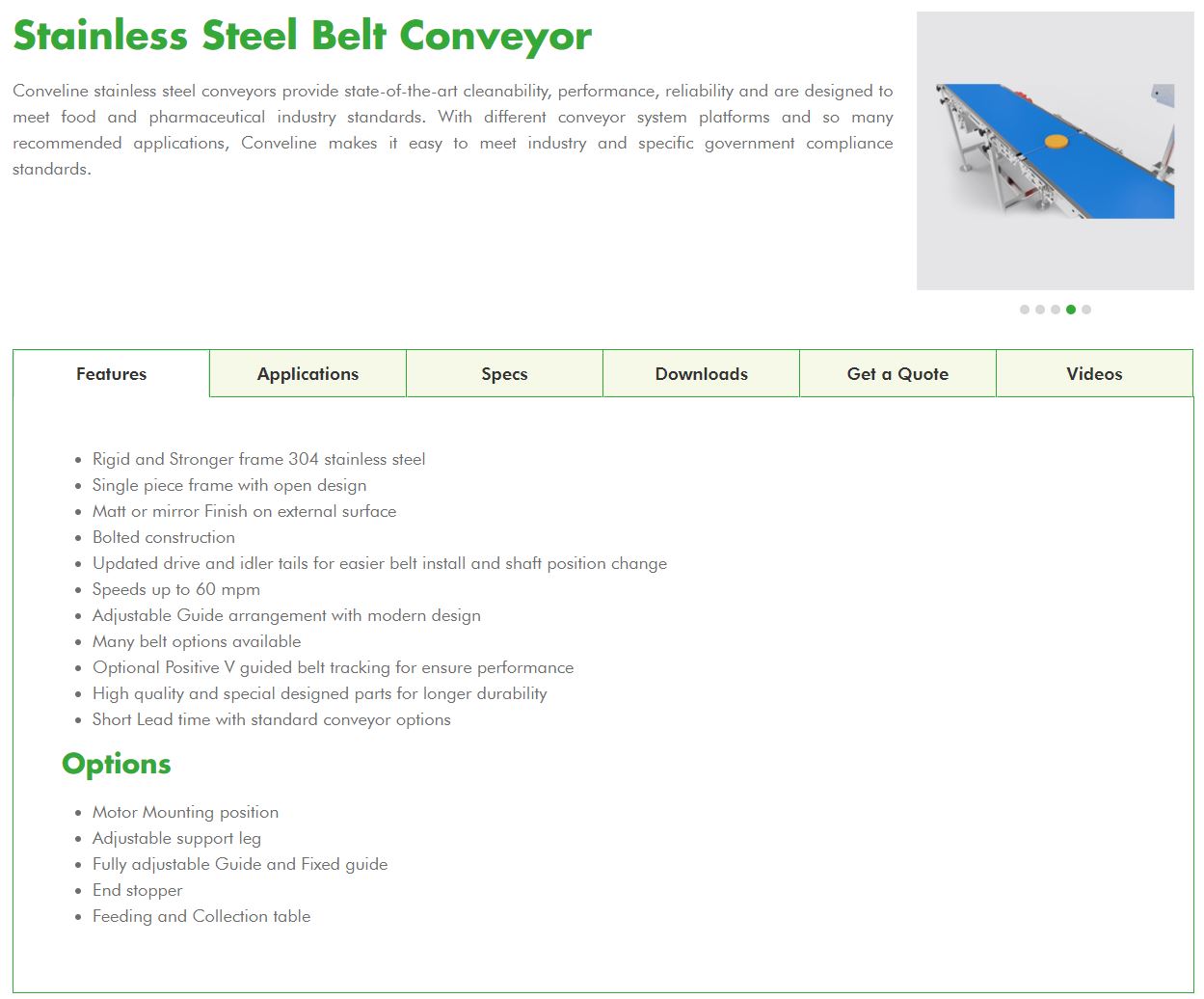
A thorough assessment of existing systems forms the foundation of any successful retrofit. Before integrating a food packaging conveyor, the line layout, structural integrity, and operational workflows must be reviewed. Stainless steel construction, which defines modern stainless steel food conveyors, often replaces aging painted or mild steel structures to meet strict hygiene demands.
Assessment includes checking for bottlenecks, outdated material transfer points, wear patterns, and cleaning challenges. Identifying structural limitations early prevents costly modifications during installation.
System assessments must also consider the changing nature of food products handled. Delicate, sticky, or irregularly shaped items require modern food industry conveyor solutions with superior handling capabilities compared to traditional systems built for uniform, packaged goods. Retrofit planning must align new components with both current and projected product specifications.
Identifying Opportunities for Upgrades
Opportunities for upgrading existing lines come from observing where traditional conveyors struggle. Frequent downtime, sanitation issues, and inconsistent transfer between processing stages highlight areas where retrofitting with a food packaging conveyor provides measurable improvements
Key examples include replacing older belt materials with food-grade modular belts, implementing hygienic drive systems, and introducing quick-release designs for easy cleaning. Stainless steel food conveyors address corrosion issues common in environments requiring daily high-pressure sanitation.
Design updates such as fully welded frames, CIP (Clean-in-Place) components, and minimal flat surfaces contribute to better hygiene and operational longevity.
Energy usage and maintenance demand analysis further guide upgrade decisions. New food industry conveyor solutions optimize energy distribution across drives and motors while simplifying maintenance routines. Well-chosen upgrades modernize existing systems into production assets ready for new product lines and changing regulatory environments.
Implementation Strategies
Successful retrofit implementation demands careful project management and sequencing. System shutdowns must align with production downtimes to minimize disruption. Pre-fabrication and modular design elements, particularly from stainless steel food conveyors, allow quick on-site assembly with minimal operational impact.
Implementation strategies include phased replacements, where sections of the conveyor line are updated one at a time. Temporary bypass systems keep production flowing while new conveyors are installed. Detailed installation drawings, simulations, and mock-ups help visualize integration before physical changes occur.
Training and documentation cannot be overlooked. Even the most advanced food packaging conveyor design loses effectiveness if maintenance crews and operators do not understand its features. Modern food industry conveyor solutions prioritize intuitive design but updated operational procedures and maintenance routines must accompany the physical installation to realize full value.
Benefits of Modernization
Modernization of legacy lines through retrofitting introduces immediate and long-term advantages. Improved food safety compliance is a primary outcome, as stainless steel food conveyors with hygienic designs simplify sanitation and inspection processes.
Operational uptime also sees measurable improvement when older mechanical components are replaced with more consistent, low-maintenance solutions.
A food packaging conveyor designed for quick cleaning and faster inspection directly increases production availability.
Modern food industry conveyor solutions support future automation strategies. Facilities upgrading today can position themselves to integrate robotics, smart sensors, and predictive maintenance technologies tomorrow.
In Conclusion
Retrofitting material handling systems with modern food industry conveyor solutions requires careful assessment, strategic upgrades, and disciplined execution. Facilities that approach modernization methodically unlock new levels of food safety, production flexibility, and operational resilience.
Experienced food conveyor manufacturers play a key part in these modernization projects, offering custom-engineered components and layout designs that fit into existing systems without complete rebuilds. Work with CONOVEY to retrofit your production lines with modern food packaging conveyors engineered for today’s food industry requirements.


- Various Drive Options
- Tapered Rollers also available
- Optional Polyurethane sleeving
- Variable speed is standard
- Safe low voltage & wide range of speeds
- 1201/1202 | Belt Rollers, Single or Double Groove Light/Medium Duty Conveyors Rollers, Custom Made Grooves | ⌀50mm Roller | ⌀11mm, ⌀14mm Shafts
- 1203 | Belt Pulley Rollers, Light/Medium Duty Conveyor Rollers | ⌀50mm Roller | ⌀11mm, ⌀14mm Shafts
- Suitable for wide range of application for Buffer or accumulation require
- Single drive with start/stop application suitable
- Single or double 14 teeth x 1/2” sprockets can be fitted (choice of steel or nylon sprockets)
- Mild steel and stainless steel options
- Stainless steel options available for all fixed driven conveyor rollers
- 1301/1302 | Polymer sprocket rollers, single or double sprocket, low running noise, polyamide bearing housing | 50mm Dia | ⌀14mm Shaft
- 1303/1304 | Steel sprocket, single or double sprocket, polyamide bearing housing | ⌀50mm Roller | ⌀14mm Shafts
- 1305/1306 | Steel sprocket, adjustable torque, single or double sprocket, polyamide/steel bearing housing | ⌀50mm, ⌀60mm, ⌀76 mm Rollers | ⌀14mm, ⌀15mm, ⌀20mm Shafts
- 1201/1202 | belt rollers, single or double groove light/medium duty conveyor rollers, custom made groove | ⌀50mm Roller | ⌀11mm, ⌀14mm Shafts
- 1203 | Belt Pulley Rollers, Light/Medium Duty Conveyor Rollers | ⌀50mm Roller | ⌀11mm, ⌀14mm Shafts
- Single and Double Grooves option
- Light and medium duty driven roller fitter with nylon O ring sprocket
- Line-shaft and 24V DC motorized rollers conveyors
- Mild steel, stainless steel and plastic options
- Stainless steel options available for all fixed driven conveyor rollers
- Free running bearings
- Wide range of tube and shaft options
- Wide range to handle from 100gm to 500kg per roller capacity
- Mild steel, stainless steel and plastic options
- Our most economical price rollers
- 1101 | PVC tube, polyamide bearing housing, light duty conveyor rollers | ⌀25mm, ⌀38mm, ⌀50mm Rollers | ⌀10mm, ⌀12mm Shafts
- 1102 | Light and medium duty universal conveyor rollers, polyamide bearing housing | ⌀25mm, ⌀38mm, ⌀50mm, ⌀76mm, ⌀89mm Rollers | ⌀14mm, ⌀20mm Shafts
- 1103 | Gravity conveyor rollers, steel bearing housing | ⌀50mm, ⌀76mm, ⌀89mm Rollers | ⌀14mm, ⌀20mm Shafts
- 1201/1202 | belt rollers, single or double groove light/medium duty conveyor rollers, custom made groove | ⌀50mm Roller | ⌀11mm, ⌀14mm Shafts
- 1203 | Belt Pulley Rollers, Light/Medium Duty Conveyor Rollers | ⌀50mm Roller | ⌀11mm, ⌀14mm Shafts
- 1204 | Poly V belt pulley rollers, medium duty and high speed conveyor rollers | ⌀50mm Roller | ⌀11mm, ⌀14mm Shafts
- 1205 | Timing belt pulley rollers, medium duty and high speed conveyor rollers | ⌀50mm Roller | ⌀11mm, ⌀14mm Shafts
- 1206/1207 | Polymer sprocket rollers, single or double sprocket, medium duty and low running noise, polyamide bearing housing | ⌀50mm Roller | ⌀14mm Shafts
- 1208/1209 | Steel sprocket, single or double sprocket, medium/heavy duty conveying application, polyamide bearing housing | ⌀50mm, ⌀60mm, ⌀76mm Rollers, ⌀89mm Roller | ⌀14mm, ⌀15mm, ⌀20mm Shafts
- 1210/1211 | Steel sprocket, steel bearing housing, heavy duty conveying, strong and reliable | ⌀50mm, ⌀76mm, ⌀89mm Rollers | ⌀14mm, ⌀15mm, ⌀20mm Shafts
- Free running option for gravity roller conveyors.
- All tapered conveyor rollers have a sealed bearing option for wash-down areas
- 50mm diameter base roller can be grooved for line-shaft conveyors
- Tapered sleeve rollers to suits an inside radius of 500mm to 1200mm
- Single or double 14 teeth x 1/2” sprockets can be fitted (choice of steel or nylon sprockets)
- Mild steel and stainless steel options
- Stainless steel options available for all fixed driven conveyor rollers
- 1401 | Gravity tapered roller, attractive look and low noise | ⌀53mm, ⌀56mm, ⌀50mm Rollers | ⌀12mm, ⌀14mm Shafts
- 1402 | belt drive, Double grooved tapered sleeve roller, customized groove position | ⌀53mm, ⌀56mm, ⌀50mm Rollers | ⌀14mm Shaft
- 1403 | belt pulley drive, Double grooved O belt pulley tapered sleeve roller | ⌀53mm, ⌀56mm, ⌀50mm Rollers | ⌀14mm Shaft
- 1404 | Poly vee belt pulley drive tapered sleeve roller, high speed, low noise | ⌀53mm, ⌀56mm, ⌀50mm Rollers | ⌀14mm Shaft
- 1405 | Polymer sprocket drive tapered sleeve roller, medium duty, low noise | ⌀53mm, ⌀56mm, ⌀50mm Rollers | ⌀14mm Shaft
- Widths | 250mm, 350mm, 450mm, 650mm, 850mm |
- Lengths | 500mm, 1000mm, 1500mm, 2000mm, 2500mm |
- Max Pallet/Carrier Wgt (kg) | 50kg/250kg |
- Pallet Sizes | 238X306, 332X430, 428X550, 522X670 |
- Height Range | 500mm - 1000mm |
- Load Accuracy | +/-0.5mm Stop Unit | +/-0.1mm Locating Pin | +/-.05mm Lift & Locate |
- Roller Pitch | 82.5mm, 127mm, 150.8mm |
- Roller ⌀ | 50mm, 76mm |
- Max Length per Drive | 7500mm |
- Drive Motor Size | .5HP, 1HP | SEW |
- Drive Speeds | 2-24 mpm
- Frame Materials | Aluminum or Powder Coat Mild Steel
- High energy efficiency level with different load application
- Safe, affordable operation without the need for guarding
- Tight positioning tolerances thanks to high precision guide rails
- Active braking and lifting of the Pallets
- Unlimited zero pressure accumulation of Pallets
- Flexible speeds from 0.2 to 24m/min between communication points
- Constant 24V auxiliary power available for energy Saving
- Very limited preventative maintenance required
- No track maintenance due to no moving parts in the track
- Very low noise level, less than 60db(A)
- Easy tracking of the Carts/parts throughout the layout
- Highly standardized components
- Significantly reduced wiring and commissioning time
- Low profile for easy part access around the line
- Tip protection for overhanging loads optionally available
- Adaptable pallet length to fit the size of your part