Modular Chain vs Fabric Belt: Selecting the Right Food Packaging Conveyor

How Conveyor Manufacturers Support Automation Strategy
May 6, 2026
How Conveyor Parts Manufacturers Optimize Food Processing Lines
May 7, 2026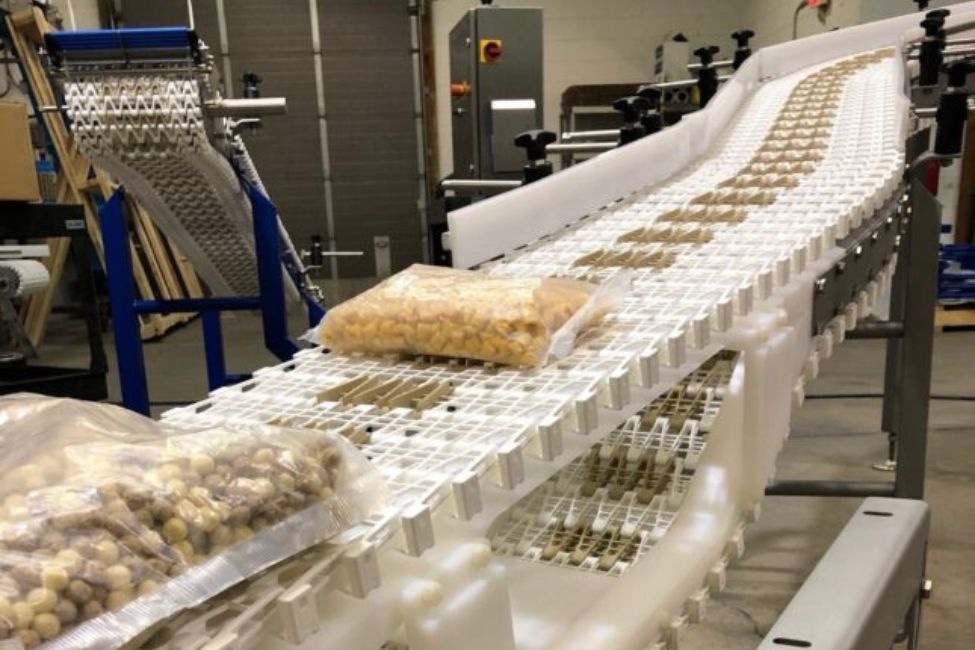
Selecting the appropriate food packaging conveyor influences throughput stability, sanitation compliance, and long-term operational efficiency. Modular chain and fabric belt conveyors each offer distinct performance characteristics, making the selection dependent on product type, processing conditions, and facility layout. A structured comparison helps define the most suitable option for high-performance packaging operations.
Performance and Layout Flexibility in a Food Packaging Conveyor
Modular Chain Tracking and Curved Layouts
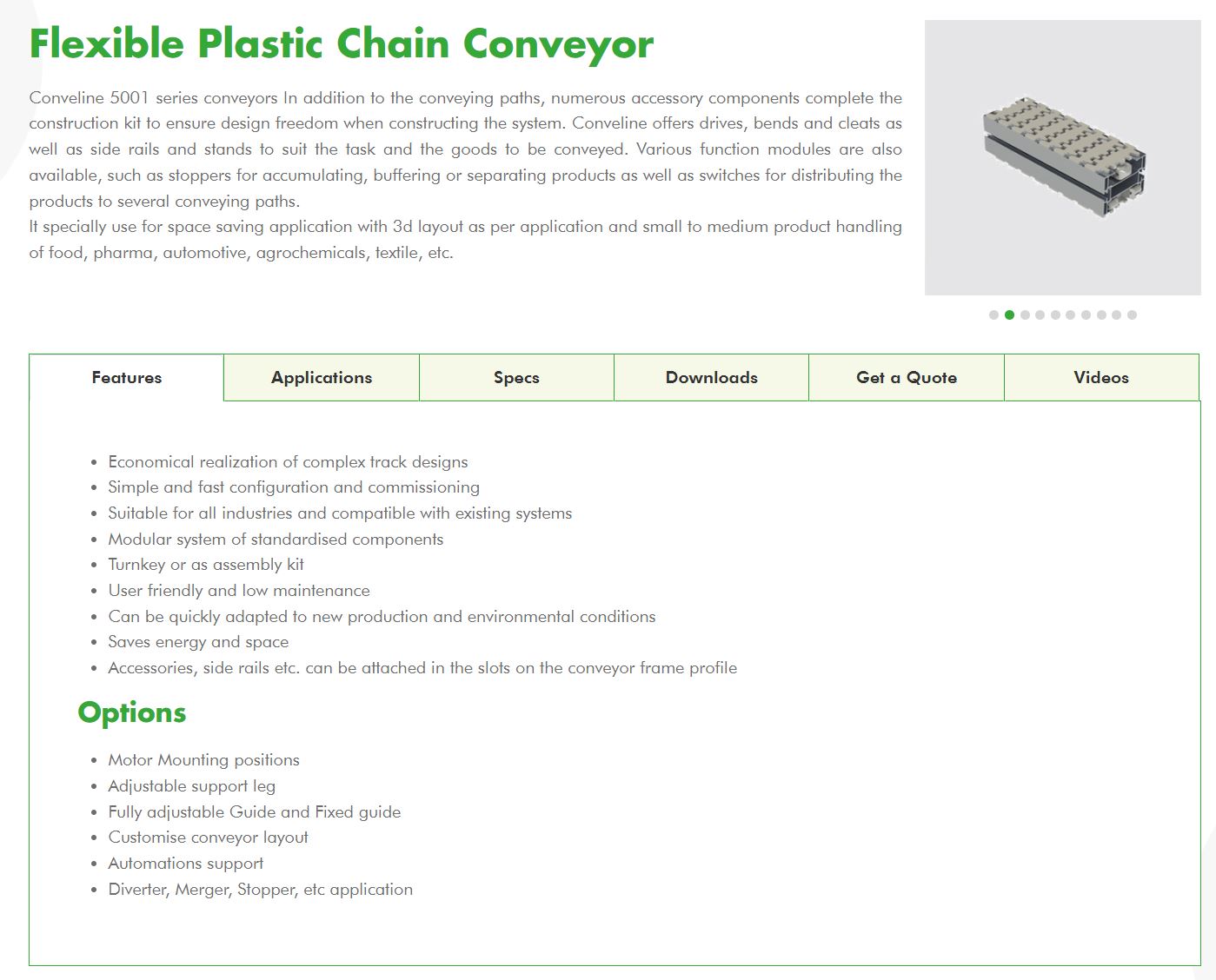
Modular chain automated conveyors are well-suited for applications requiring curved paths or elevation changes. Interlocking modules maintain consistent tracking across directional shifts, supporting product stability in complex layouts. This configuration is often applied in processes involving cooling, draining, or multi-stage routing.
Fabric Belt Precision and High-Speed Operation
Fabric belt packaging line conveyors perform efficiently in straight-line, high-speed environments. Their smooth surface supports precise indexing and minimal vibration, which is critical for lightweight packaging formats. This makes fabric belts a strong option where consistent positioning and rapid movement are required.
Hygiene Compliance and Washdown Standards
Cleanability and Surface Design
Hygienic performance depends on belt construction and surface characteristics. Monolithic fabric belts provide a continuous surface that minimizes potential areas for residue accumulation. Modular chain belts, by contrast, allow fluid passage through open structures, which can support drainage in wet environments.
Material Resistance to Cleaning Agents
Different materials respond differently to cleaning chemicals and washdown conditions. Modular plastic components typically offer strong resistance to sanitizing agents, while certain fabric belts require specification for chemical compatibility to prevent degradation. Material selection should align with cleaning frequency and sanitation protocols.
Cost Considerations and Maintenance Requirements
Initial Investment and Long-Term Value
Modular chain configurations generally involve higher initial investment due to precision-molded components and specialized drive elements. Fabric belt options often present lower upfront cost, but replacement frequency and wear characteristics can influence long-term operating cost.
Repair and Replacement Efficiency
Modular chain designs allow replacement of individual sections, reducing downtime during maintenance. Fabric belts typically require full replacement when damaged, which can increase maintenance duration. Maintenance strategy should consider both repair speed and operational continuity.
Integration Considerations for a Food Packaging Conveyor
Alignment with Upstream and Downstream Equipment
Effective integration requires smooth transitions between conveyors and adjacent equipment. Modular chain configurations support heavier loads at transfer points, while fabric belts provide consistent surface contact for lightweight products. Matching conveyor type to product characteristics helps maintain stable flow across the line.
Energy Efficiency and Material Selection
Drive efficiency and material resistance influence energy consumption. Fabric belts typically require less drive force on straight runs, while optimized modular chain designs can reduce torque requirements through improved geometry. Material selection also contributes to sustainability goals by supporting longer component life and reduced replacement frequency.
Evaluating Food Conveyor Manufacturers and Suppliers
Engineering Capability and Support
Selecting from established food conveyor manufacturers requires evaluation of engineering capability, customization flexibility, and support throughout installation and operation. Build-to-order configurations ensure alignment with facility requirements and reduce the need for field modifications.
Compliance and Certification Standards
Reliable food conveyor suppliers provide documentation for material certifications, washdown ratings, and structural specifications. Verification of compliance supports audit readiness and reduces the risk of operational disruption due to regulatory gaps.
Conclusion
Selecting the right food packaging conveyor depends on balancing product characteristics, layout complexity, sanitation requirements, and maintenance considerations. Modular chain configurations support flexible layouts and targeted repairs, while fabric belts provide advantages in high-speed, straight-line applications. A structured evaluation process ensures consistent performance and long-term operational stability.
For operations evaluating conveyor performance and integration strategies, Conovey provides engineering expertise to align equipment selection with processing requirements. Connect with Conovey to assess operational needs and identify reliable solutions from trusted manufacturers and experienced food conveyor suppliers.


- Various Drive Options
- Tapered Rollers also available
- Optional Polyurethane sleeving
- Variable speed is standard
- Safe low voltage & wide range of speeds
- 1201/1202 | Belt Rollers, Single or Double Groove Light/Medium Duty Conveyors Rollers, Custom Made Grooves | ⌀50mm Roller | ⌀11mm, ⌀14mm Shafts
- 1203 | Belt Pulley Rollers, Light/Medium Duty Conveyor Rollers | ⌀50mm Roller | ⌀11mm, ⌀14mm Shafts
- Suitable for wide range of application for Buffer or accumulation require
- Single drive with start/stop application suitable
- Single or double 14 teeth x 1/2” sprockets can be fitted (choice of steel or nylon sprockets)
- Mild steel and stainless steel options
- Stainless steel options available for all fixed driven conveyor rollers
- 1301/1302 | Polymer sprocket rollers, single or double sprocket, low running noise, polyamide bearing housing | 50mm Dia | ⌀14mm Shaft
- 1303/1304 | Steel sprocket, single or double sprocket, polyamide bearing housing | ⌀50mm Roller | ⌀14mm Shafts
- 1305/1306 | Steel sprocket, adjustable torque, single or double sprocket, polyamide/steel bearing housing | ⌀50mm, ⌀60mm, ⌀76 mm Rollers | ⌀14mm, ⌀15mm, ⌀20mm Shafts
- 1201/1202 | belt rollers, single or double groove light/medium duty conveyor rollers, custom made groove | ⌀50mm Roller | ⌀11mm, ⌀14mm Shafts
- 1203 | Belt Pulley Rollers, Light/Medium Duty Conveyor Rollers | ⌀50mm Roller | ⌀11mm, ⌀14mm Shafts
- Single and Double Grooves option
- Light and medium duty driven roller fitter with nylon O ring sprocket
- Line-shaft and 24V DC motorized rollers conveyors
- Mild steel, stainless steel and plastic options
- Stainless steel options available for all fixed driven conveyor rollers
- Free running bearings
- Wide range of tube and shaft options
- Wide range to handle from 100gm to 500kg per roller capacity
- Mild steel, stainless steel and plastic options
- Our most economical price rollers
- 1101 | PVC tube, polyamide bearing housing, light duty conveyor rollers | ⌀25mm, ⌀38mm, ⌀50mm Rollers | ⌀10mm, ⌀12mm Shafts
- 1102 | Light and medium duty universal conveyor rollers, polyamide bearing housing | ⌀25mm, ⌀38mm, ⌀50mm, ⌀76mm, ⌀89mm Rollers | ⌀14mm, ⌀20mm Shafts
- 1103 | Gravity conveyor rollers, steel bearing housing | ⌀50mm, ⌀76mm, ⌀89mm Rollers | ⌀14mm, ⌀20mm Shafts
- 1201/1202 | belt rollers, single or double groove light/medium duty conveyor rollers, custom made groove | ⌀50mm Roller | ⌀11mm, ⌀14mm Shafts
- 1203 | Belt Pulley Rollers, Light/Medium Duty Conveyor Rollers | ⌀50mm Roller | ⌀11mm, ⌀14mm Shafts
- 1204 | Poly V belt pulley rollers, medium duty and high speed conveyor rollers | ⌀50mm Roller | ⌀11mm, ⌀14mm Shafts
- 1205 | Timing belt pulley rollers, medium duty and high speed conveyor rollers | ⌀50mm Roller | ⌀11mm, ⌀14mm Shafts
- 1206/1207 | Polymer sprocket rollers, single or double sprocket, medium duty and low running noise, polyamide bearing housing | ⌀50mm Roller | ⌀14mm Shafts
- 1208/1209 | Steel sprocket, single or double sprocket, medium/heavy duty conveying application, polyamide bearing housing | ⌀50mm, ⌀60mm, ⌀76mm Rollers, ⌀89mm Roller | ⌀14mm, ⌀15mm, ⌀20mm Shafts
- 1210/1211 | Steel sprocket, steel bearing housing, heavy duty conveying, strong and reliable | ⌀50mm, ⌀76mm, ⌀89mm Rollers | ⌀14mm, ⌀15mm, ⌀20mm Shafts
- Free running option for gravity roller conveyors.
- All tapered conveyor rollers have a sealed bearing option for wash-down areas
- 50mm diameter base roller can be grooved for line-shaft conveyors
- Tapered sleeve rollers to suits an inside radius of 500mm to 1200mm
- Single or double 14 teeth x 1/2” sprockets can be fitted (choice of steel or nylon sprockets)
- Mild steel and stainless steel options
- Stainless steel options available for all fixed driven conveyor rollers
- 1401 | Gravity tapered roller, attractive look and low noise | ⌀53mm, ⌀56mm, ⌀50mm Rollers | ⌀12mm, ⌀14mm Shafts
- 1402 | belt drive, Double grooved tapered sleeve roller, customized groove position | ⌀53mm, ⌀56mm, ⌀50mm Rollers | ⌀14mm Shaft
- 1403 | belt pulley drive, Double grooved O belt pulley tapered sleeve roller | ⌀53mm, ⌀56mm, ⌀50mm Rollers | ⌀14mm Shaft
- 1404 | Poly vee belt pulley drive tapered sleeve roller, high speed, low noise | ⌀53mm, ⌀56mm, ⌀50mm Rollers | ⌀14mm Shaft
- 1405 | Polymer sprocket drive tapered sleeve roller, medium duty, low noise | ⌀53mm, ⌀56mm, ⌀50mm Rollers | ⌀14mm Shaft
- Widths | 250mm, 350mm, 450mm, 650mm, 850mm |
- Lengths | 500mm, 1000mm, 1500mm, 2000mm, 2500mm |
- Max Pallet/Carrier Wgt (kg) | 50kg/250kg |
- Pallet Sizes | 238X306, 332X430, 428X550, 522X670 |
- Height Range | 500mm - 1000mm |
- Load Accuracy | +/-0.5mm Stop Unit | +/-0.1mm Locating Pin | +/-.05mm Lift & Locate |
- Roller Pitch | 82.5mm, 127mm, 150.8mm |
- Roller ⌀ | 50mm, 76mm |
- Max Length per Drive | 7500mm |
- Drive Motor Size | .5HP, 1HP | SEW |
- Drive Speeds | 2-24 mpm
- Frame Materials | Aluminum or Powder Coat Mild Steel
- High energy efficiency level with different load application
- Safe, affordable operation without the need for guarding
- Tight positioning tolerances thanks to high precision guide rails
- Active braking and lifting of the Pallets
- Unlimited zero pressure accumulation of Pallets
- Flexible speeds from 0.2 to 24m/min between communication points
- Constant 24V auxiliary power available for energy Saving
- Very limited preventative maintenance required
- No track maintenance due to no moving parts in the track
- Very low noise level, less than 60db(A)
- Easy tracking of the Carts/parts throughout the layout
- Highly standardized components
- Significantly reduced wiring and commissioning time
- Low profile for easy part access around the line
- Tip protection for overhanging loads optionally available
- Adaptable pallet length to fit the size of your part