What Robotic Cells Need From The Conveyors Feeding Them

Vibratory Feeders Vs Belt Conveyors For Bulk And Fragile Products
November 12, 2026
9 Signs Your Conveyor Line Is Capping Your Production Rate
November 16, 2026
Robot cells are designed around the robot, and conveyors on both sides can devalue them. A pick, place, or palletizing cell will only achieve its rated rate if the product is presented in a spaced, indexed, oriented and tracked manner. Conveyor manufacturers that recognize this view the conveyor as an integral part of the cell, not an accessory tacked on to the robot after it’s selected.
People Also Ask
Why does a robot cell run below its rated speed even with a fast robot?
Typically, the conveyor feeding the robot cell (not the robot itself) defines the cell’s real-world maximum speed. The robot is forced to slow down because of poor spacing, product tumbling, or missed picks due to a lack of tracking.
What is conveyor tracking in robotics?
An encoder feeds the robot controller the conveyor’s actual position. It allows the robot to calculate the position of a moving target without waiting for the conveyor to stop.
Does a robotic cell need a vision system if it already has an encoder?
Often both. The encoder tracks position along the belt, while vision identifies what the product is and where it sits across the belt width.
Why Conveying Decides Robot Cell Throughput
A robot can only pick as fast as the product is presented. Gaps, tumbled orientation, or bunched product will idle the robot or reduce picking density, and no amount of robot speed will overcome an upstream feeding problem.
The conveyor establishes cell throughput well before the robot arm even moves.
Presenting Product To A Robot Reliably
A robot infeed conveyor succeeds or fails on three things working together: spacing, orientation, and lane control.
Consistent Pitch And Spacing
Even, predictable spacing between products lets the robot plan the next pick-up even as it finishes the current one.
Irregular spacing forces the controller to constantly readjust, slowing the cell even if the robot can handle much higher speeds.
Orientation Control
A robot vision system can better track an approaching product which arrives in a fixed orientation, rather than tumbling end-over-end.
Guide rails, lane dividers, and less aggressive upstream handling all reduce the maneuvering the robot must do.
Single Filing And Laning
Multiple item streams presented side-by-side or overlapping can confuse both vision detection and pick sequencing.
Converting the bulk stream into a single, evenly spaced file before the pick window is often the single greatest factor in achieving a rated cycle rate. Belt condition drives many of them too, which routine maintenance practices address before they become stoppages.
Vision Systems And What The Conveyor Must Provide
A vision system conveyor needs consistent lighting, a stable belt surface free of glare or pattern noise, and predictable product position within its field of view.
A conveyor with unpredictable speed or vibration adds error the camera must compensate for on every cycle.
Encoder Feedback And Conveyor Tracking
A conveyor tracking encoder supplies the robot controller with a real-time position reference on the conveyor belt based on pulses per revolution relative to a defined conveyor pitch.
An encoder for conveyor tracking built and calibrated this way allows the robot to pick items from a belt that never stops moving.
Managing Flow Variability Ahead Of The Cell
Upstream processes rarely maintain a perfectly consistent rate. As an automation conveyor, Fastback Feeders, made in-house at CONOVEY, take an inconsistent bulk stream and provide a controlled, evenly spaced flow before it arrives at the pick window, ensuring the robot always works against a predictable feed, not a surge-and-gap cycle. How that feeder compares to a belt for fragile product is covered in vibratory feeders versus belt conveyors.
Accumulation Either Side Of The Robot
A robot processing through a case may occasionally lag behind the upstream arrival rate.
Zone-controlled accumulation on CDLR platforms enables buffering without stopping the entire line, absorbing this discrepancy rather than causing a line stop due to a minor slowdown. Without it, the cell becomes a point where the line quietly caps out.
Activated Roller Belt Technology For Transfers And Turns
Activated Roller Belt, or ARB, shifts and merges product without a mechanical arm making contact, which matters for delicate packaging ahead of a pick point.
On a project with JMP Solutions, CONOVEY’s sanitary ARB conveyors handled case orientation and collating directly ahead of the robot pick point on a large-scale case handling project at Tyson Foods. Sanitary builds like that one depend on frame material choice as much as belt type.
High Speed Switching And Diverting
CONOVEY’s jam-proof ARB switch runs up to 400 switches per minute across configurations such as 1:2, 1:3, and 2:4, diverting product at an angle without the sharp acceleration a side belt transfer creates.
For robotic cells running multiple pick stations off one line, this keeps each station fed without a bottleneck at the split point.
Robot Frames, Cages And Guarding
CONOVEY designs and builds robot frames and cages for Flex Pickers and other robotic platforms, so the conveyor and supporting structure around robots come from a single entity rather than two vendors reconciling their equipment after installation.
Palletizing Infeed And Case Handling
A robotic palletizer conveyor handles whether the robot stacks cleanly at rate or around misaligned cases.
Get case orientation and collating right upstream, not by asking the robot to correct for it, so the Tyson Foods project referenced above hit its automation targets.
Designing For The Integrator Rather Than The End User
An integrator needs a conveyor for robotic automation which arrives with documented interfaces, known tracking behaviour, and a frame built to the robot’s mounting requirements, not a generic conveyor for integrators to adapt on site. Early collaboration between the conveyor manufacturer and the integrator avoids rework once the robot program is written. That collaboration starts with choosing a conveyor manufacturer who builds to documented interfaces rather than a generic spec.
Commissioning A Cell And Conveyor Together
CONOVEY provides 3D CAD models and STEP files before fabrication, enabling time-saving inspection of clearances and mounting points on a graphic representation of the robot cell before equipment installation.
Commissioning the conveyor and robot simultaneously, rather than one after another, reveals timing and interference problems early, when changes are simple and inexpensive.
A Pre-Design Checklist For Robotic Cells
Confirm product spacing and orientation requirements. Define vision lighting and belt surface needs. Specify encoder tracking accuracy required.
Size accumulation on both sides of the cell. Share robot mounting and guarding requirements early with the conveyor manufacturer. These sit alongside the specifications that belong in any conveyor quote request.
Getting The Conveyor Right Before The Robot Arrives
Robotic cells rarely perform poorly because the robot is slow; they perform poorly because the conveyor feeding the robot was treated as an afterthought.
Spacing, orientation, tracking, and accumulation must all be correct before the robot can pick up the part.
Planning a robotic cell and need the conveying side designed around it from the start? Contact CONOVEY or call 1 (844) 876 8889.
Frequently Asked Questions
What conveyor type works best for feeding a robot vision system?
How much accumulation does a robotic cell typically need?
Can an existing conveyor be adapted for a new robotic cell?


Related posts


- Various Drive Options
- Tapered Rollers also available
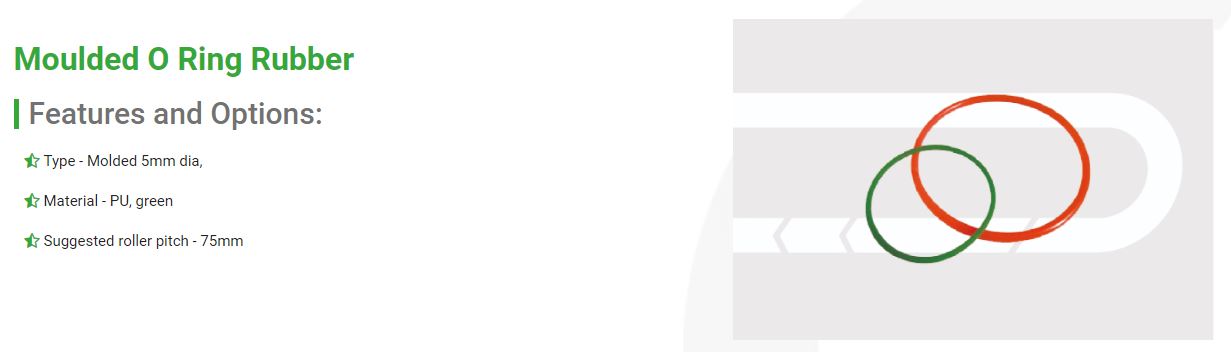
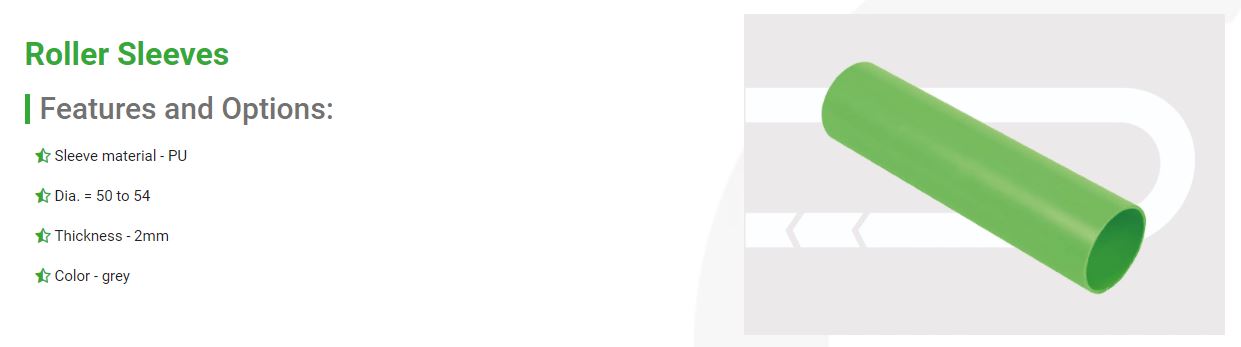
- Optional Polyurethane sleeving
- Variable speed is standard
- Safe low voltage & wide range of speeds
- 1201/1202 | Belt Rollers, Single or Double Groove Light/Medium Duty Conveyors Rollers, Custom Made Grooves | ⌀50mm Roller | ⌀11mm, ⌀14mm Shafts
- 1203 | Belt Pulley Rollers, Light/Medium Duty Conveyor Rollers | ⌀50mm Roller | ⌀11mm, ⌀14mm Shafts
- Suitable for wide range of application for Buffer or accumulation require
- Single drive with start/stop application suitable
- Single or double 14 teeth x 1/2” sprockets can be fitted (choice of steel or nylon sprockets)
- Mild steel and stainless steel options
- Stainless steel options available for all fixed driven conveyor rollers
- 1301/1302 | Polymer sprocket rollers, single or double sprocket, low running noise, polyamide bearing housing | 50mm Dia | ⌀14mm Shaft
- 1303/1304 | Steel sprocket, single or double sprocket, polyamide bearing housing | ⌀50mm Roller | ⌀14mm Shafts
- 1305/1306 | Steel sprocket, adjustable torque, single or double sprocket, polyamide/steel bearing housing | ⌀50mm, ⌀60mm, ⌀76 mm Rollers | ⌀14mm, ⌀15mm, ⌀20mm Shafts
- 1201/1202 | belt rollers, single or double groove light/medium duty conveyor rollers, custom made groove | ⌀50mm Roller | ⌀11mm, ⌀14mm Shafts
- 1203 | Belt Pulley Rollers, Light/Medium Duty Conveyor Rollers | ⌀50mm Roller | ⌀11mm, ⌀14mm Shafts
- Single and Double Grooves option
- Light and medium duty driven roller fitter with nylon O ring sprocket
- Line-shaft and 24V DC motorized rollers conveyors
- Mild steel, stainless steel and plastic options
- Stainless steel options available for all fixed driven conveyor rollers
- Free running bearings
- Wide range of tube and shaft options
- Wide range to handle from 100gm to 500kg per roller capacity
- Mild steel, stainless steel and plastic options
- Our most economical price rollers
- 1101 | PVC tube, polyamide bearing housing, light duty conveyor rollers | ⌀25mm, ⌀38mm, ⌀50mm Rollers | ⌀10mm, ⌀12mm Shafts
- 1102 | Light and medium duty universal conveyor rollers, polyamide bearing housing | ⌀25mm, ⌀38mm, ⌀50mm, ⌀76mm, ⌀89mm Rollers | ⌀14mm, ⌀20mm Shafts
- 1103 | Gravity conveyor rollers, steel bearing housing | ⌀50mm, ⌀76mm, ⌀89mm Rollers | ⌀14mm, ⌀20mm Shafts
- 1201/1202 | belt rollers, single or double groove light/medium duty conveyor rollers, custom made groove | ⌀50mm Roller | ⌀11mm, ⌀14mm Shafts
- 1203 | Belt Pulley Rollers, Light/Medium Duty Conveyor Rollers | ⌀50mm Roller | ⌀11mm, ⌀14mm Shafts
- 1204 | Poly V belt pulley rollers, medium duty and high speed conveyor rollers | ⌀50mm Roller | ⌀11mm, ⌀14mm Shafts
- 1205 | Timing belt pulley rollers, medium duty and high speed conveyor rollers | ⌀50mm Roller | ⌀11mm, ⌀14mm Shafts
- 1206/1207 | Polymer sprocket rollers, single or double sprocket, medium duty and low running noise, polyamide bearing housing | ⌀50mm Roller | ⌀14mm Shafts
- 1208/1209 | Steel sprocket, single or double sprocket, medium/heavy duty conveying application, polyamide bearing housing | ⌀50mm, ⌀60mm, ⌀76mm Rollers, ⌀89mm Roller | ⌀14mm, ⌀15mm, ⌀20mm Shafts
- 1210/1211 | Steel sprocket, steel bearing housing, heavy duty conveying, strong and reliable | ⌀50mm, ⌀76mm, ⌀89mm Rollers | ⌀14mm, ⌀15mm, ⌀20mm Shafts
- Free running option for gravity roller conveyors.
- All tapered conveyor rollers have a sealed bearing option for wash-down areas
- 50mm diameter base roller can be grooved for line-shaft conveyors
- Tapered sleeve rollers to suits an inside radius of 500mm to 1200mm
- Single or double 14 teeth x 1/2” sprockets can be fitted (choice of steel or nylon sprockets)
- Mild steel and stainless steel options
- Stainless steel options available for all fixed driven conveyor rollers
- 1401 | Gravity tapered roller, attractive look and low noise | ⌀53mm, ⌀56mm, ⌀50mm Rollers | ⌀12mm, ⌀14mm Shafts
- 1402 | belt drive, Double grooved tapered sleeve roller, customized groove position | ⌀53mm, ⌀56mm, ⌀50mm Rollers | ⌀14mm Shaft
- 1403 | belt pulley drive, Double grooved O belt pulley tapered sleeve roller | ⌀53mm, ⌀56mm, ⌀50mm Rollers | ⌀14mm Shaft
- 1404 | Poly vee belt pulley drive tapered sleeve roller, high speed, low noise | ⌀53mm, ⌀56mm, ⌀50mm Rollers | ⌀14mm Shaft
- 1405 | Polymer sprocket drive tapered sleeve roller, medium duty, low noise | ⌀53mm, ⌀56mm, ⌀50mm Rollers | ⌀14mm Shaft
- Widths | 250mm, 350mm, 450mm, 650mm, 850mm |
- Lengths | 500mm, 1000mm, 1500mm, 2000mm, 2500mm |
- Max Pallet/Carrier Wgt (kg) | 50kg/250kg |
- Pallet Sizes | 238X306, 332X430, 428X550, 522X670 |
- Height Range | 500mm - 1000mm |
- Load Accuracy | +/-0.5mm Stop Unit | +/-0.1mm Locating Pin | +/-.05mm Lift & Locate |
- Roller Pitch | 82.5mm, 127mm, 150.8mm |
- Roller ⌀ | 50mm, 76mm |
- Max Length per Drive | 7500mm |
- Drive Motor Size | .5HP, 1HP | SEW |
- Drive Speeds | 2-24 mpm
- Frame Materials | Aluminum or Powder Coat Mild Steel
- High energy efficiency level with different load application
- Safe, affordable operation without the need for guarding
- Tight positioning tolerances thanks to high precision guide rails
- Active braking and lifting of the Pallets
- Unlimited zero pressure accumulation of Pallets
- Flexible speeds from 0.2 to 24m/min between communication points
- Constant 24V auxiliary power available for energy Saving
- Very limited preventative maintenance required
- No track maintenance due to no moving parts in the track
- Very low noise level, less than 60db(A)
- Easy tracking of the Carts/parts throughout the layout
- Highly standardized components
- Significantly reduced wiring and commissioning time
- Low profile for easy part access around the line
- Tip protection for overhanging loads optionally available
- Adaptable pallet length to fit the size of your part