11 Things To Include When You Ask A Conveyor Company For A Quote

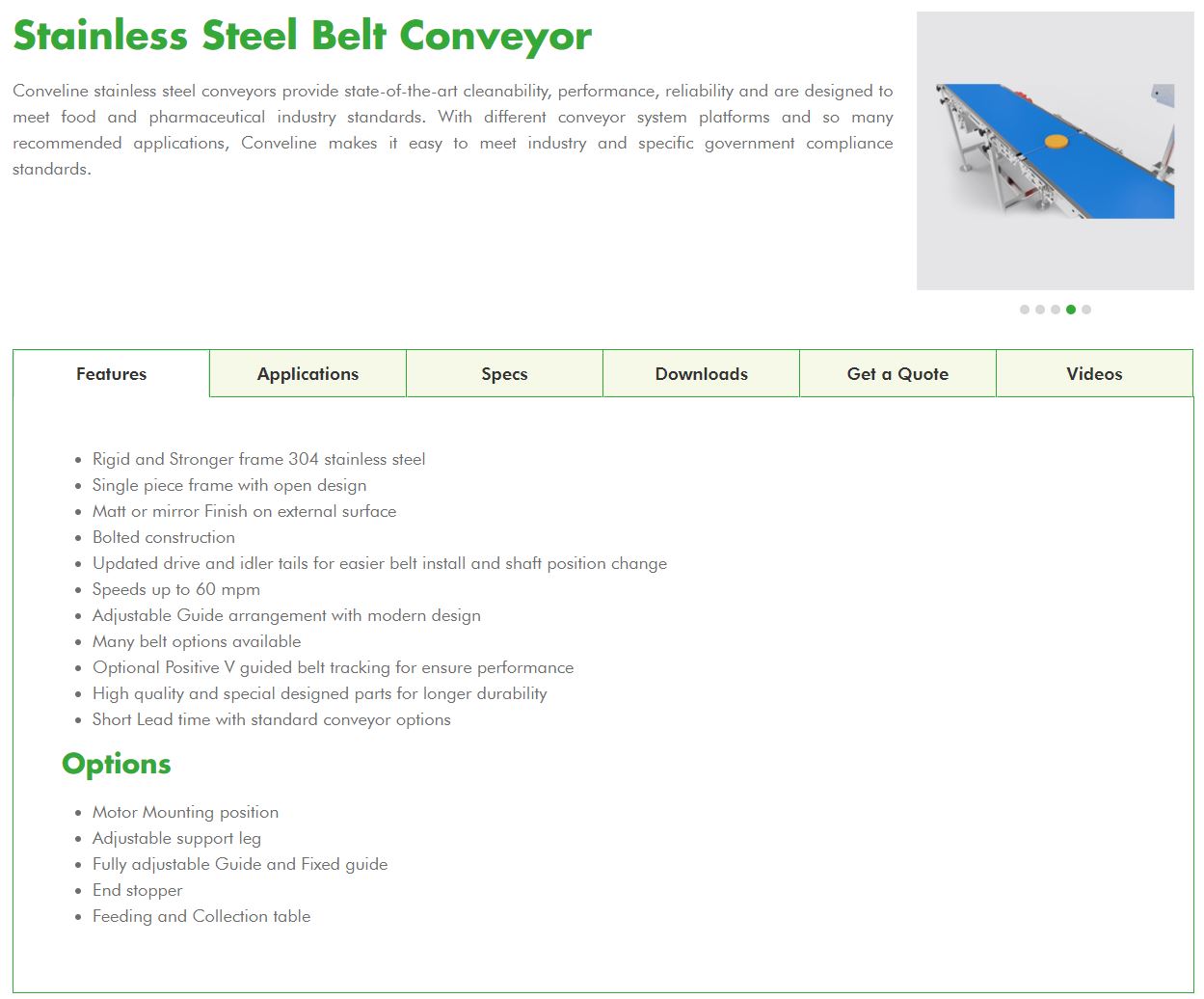
Choosing Between Aluminum, Mild Steel, and Stainless Conveyor Frames
October 2, 2026
A conveyor quote is only as good as the product data behind it. Most quoting delays, and most mis-specified lines needing rework after installation, trace back to five or six missing numbers, not a complicated project. Send conveyor companies a complete picture upfront, and you’ll get a custom conveyor quote back faster, priced closer to your real conveyor design requirements. Our guide on how to choose a conveyor manufacturer explains what happens after the quote, from design review to installation.
People Also Ask
What information does a conveyor company need for an accurate quote?
Product dimensions, weight, throughput, wash regime, layout and any equipment the conveyor needs to connect with. If you leave anything out, they’ll come back asking for the missing info.
How long does a conveyor RFQ usually take to turn around?
It depends on how complete the request is. A complete RFQ can yield a quote in days, whereas an incomplete RFQ will require back-and-forth until you provide all the necessary information.
1. Describe The Product, Not Only The Category
The terms “frozen food” or “cartons” don’t give the manufacturer much information. Instead, describe the product in detail.
Ask:
What does the packaging look like?
What does the item’s surface look like?
Is it rigid, bagged, or loose?
Two items in the same category can act completely differently on a belt.
2. Give Dimensions And Weight, Including Worst Case
Average dimensions undersize a build. Use the largest, heaviest, and smallest item that the line needs to handle, not just a typical example.
Use worst-case numbers, not averages, to size the frame and drive correctly.
3. State Throughput In Units Per Minute
“High volume” means nothing on a spec sheet. State a real number, units per minute or cases per hour, at both current and peak production rates.
The gap between the two matters. A conveyor sized for your average 40 cases a minute will choke the first time a promotion pushes the line to 55.
4. Confirm Orientation And Whether It Must Be Maintained
Some products need a specific orientation preserved end to end, such as a label facing up for inspection. Others tolerate tumbling.
State which applies, since maintaining orientation changes conveyor type and transfer design entirely.
5. Define The Wash And Sanitation Regime
Daily caustic washdown, occasional hose down, or no washdown at all changes frame material, belt type, and drive rating.
This is one of the most common gaps in a conveyor specification, and it shapes cost more than almost any other factor.
6. Supply The Layout, Footprint, and Elevations
A rough sketch or existing facility drawing showing available floor space and elevations lets a manufacturer model the actual path instead of guessing the installation constraints.
7. Identify Infeed And Discharge Equipment
Name what feeds into the new conveyor and what it discharges onto, along with their speeds and heights. A conveyor sized correctly on its own still fails if it does not match the equipment on either side.
8. Specify Accumulation Requirements
State where buffering is needed and how much. Skip it, and a small upstream delay becomes a full line shutdown.
9. State Controls And Integration Expectations
Note the conveyor’s relationship to existing PLCs, if any; whether it needs to be driven by simple zone controllers; or its relation to a robotic cell or inspection station.
The level of control will affect both design time and cost.
10. Note Environment, Temperature, and Regulatory Context
Freezer zones, humid rooms, and FDA or USDA-regulated production all demand different materials and finishes.
Flag the environment upfront rather than letting a manufacturer assume standard ambient conditions.
11. Flag Installation Access And Shipping Constraints
Note doorway widths, ceiling height, existing equipment the new conveyor must fit around, and any access restrictions during install.
This sounds obvious until a perfectly specified conveyor shows up and will not clear the loading dock door. A conveyor built to spec still causes problems if it cannot reach or fit its final location.
A Reusable Conveyor Enquiry Data Sheet
Keep one document on file with the following 11 points. Product description, dimensions, weight, throughput, orientation, wash regime, layout, connecting equipment, accumulation, controls, environment, and access.
Reusing this for all conveyor RFQs in your plant will standardize conveyor design requirements and reduce quoting time on each subsequent project.
Complete Specs Get You A Faster, More Accurate Quote
Work through these 11 points once, and conveyor system companies in Canada have what they need to price your line against your actual product, not a rough description chased down later.
Ready to request a quote? Send your specification to sales@conovey.com or call 1 (844) 876 8889 to start the conversation with CONOVEY.
Frequently Asked Questions
No. A rough sketch with key dimensions and elevations is enough to start. Formal drawings come later in the design process.
Expect a follow-up question, or a quote priced for the wrong frame material entirely, which usually means a revised proposal later.
Yes. A reusable template covering these 11 points speeds up every future conveyor quote across a plant, not only the first one.


- Various Drive Options
- Tapered Rollers also available
- Optional Polyurethane sleeving
- Variable speed is standard
- Safe low voltage & wide range of speeds
- 1201/1202 | Belt Rollers, Single or Double Groove Light/Medium Duty Conveyors Rollers, Custom Made Grooves | ⌀50mm Roller | ⌀11mm, ⌀14mm Shafts
- 1203 | Belt Pulley Rollers, Light/Medium Duty Conveyor Rollers | ⌀50mm Roller | ⌀11mm, ⌀14mm Shafts
- Suitable for wide range of application for Buffer or accumulation require
- Single drive with start/stop application suitable
- Single or double 14 teeth x 1/2” sprockets can be fitted (choice of steel or nylon sprockets)
- Mild steel and stainless steel options
- Stainless steel options available for all fixed driven conveyor rollers
- 1301/1302 | Polymer sprocket rollers, single or double sprocket, low running noise, polyamide bearing housing | 50mm Dia | ⌀14mm Shaft
- 1303/1304 | Steel sprocket, single or double sprocket, polyamide bearing housing | ⌀50mm Roller | ⌀14mm Shafts
- 1305/1306 | Steel sprocket, adjustable torque, single or double sprocket, polyamide/steel bearing housing | ⌀50mm, ⌀60mm, ⌀76 mm Rollers | ⌀14mm, ⌀15mm, ⌀20mm Shafts
- 1201/1202 | belt rollers, single or double groove light/medium duty conveyor rollers, custom made groove | ⌀50mm Roller | ⌀11mm, ⌀14mm Shafts
- 1203 | Belt Pulley Rollers, Light/Medium Duty Conveyor Rollers | ⌀50mm Roller | ⌀11mm, ⌀14mm Shafts
- Single and Double Grooves option
- Light and medium duty driven roller fitter with nylon O ring sprocket
- Line-shaft and 24V DC motorized rollers conveyors
- Mild steel, stainless steel and plastic options
- Stainless steel options available for all fixed driven conveyor rollers
- Free running bearings
- Wide range of tube and shaft options
- Wide range to handle from 100gm to 500kg per roller capacity
- Mild steel, stainless steel and plastic options
- Our most economical price rollers
- 1101 | PVC tube, polyamide bearing housing, light duty conveyor rollers | ⌀25mm, ⌀38mm, ⌀50mm Rollers | ⌀10mm, ⌀12mm Shafts
- 1102 | Light and medium duty universal conveyor rollers, polyamide bearing housing | ⌀25mm, ⌀38mm, ⌀50mm, ⌀76mm, ⌀89mm Rollers | ⌀14mm, ⌀20mm Shafts
- 1103 | Gravity conveyor rollers, steel bearing housing | ⌀50mm, ⌀76mm, ⌀89mm Rollers | ⌀14mm, ⌀20mm Shafts
- 1201/1202 | belt rollers, single or double groove light/medium duty conveyor rollers, custom made groove | ⌀50mm Roller | ⌀11mm, ⌀14mm Shafts
- 1203 | Belt Pulley Rollers, Light/Medium Duty Conveyor Rollers | ⌀50mm Roller | ⌀11mm, ⌀14mm Shafts
- 1204 | Poly V belt pulley rollers, medium duty and high speed conveyor rollers | ⌀50mm Roller | ⌀11mm, ⌀14mm Shafts
- 1205 | Timing belt pulley rollers, medium duty and high speed conveyor rollers | ⌀50mm Roller | ⌀11mm, ⌀14mm Shafts
- 1206/1207 | Polymer sprocket rollers, single or double sprocket, medium duty and low running noise, polyamide bearing housing | ⌀50mm Roller | ⌀14mm Shafts
- 1208/1209 | Steel sprocket, single or double sprocket, medium/heavy duty conveying application, polyamide bearing housing | ⌀50mm, ⌀60mm, ⌀76mm Rollers, ⌀89mm Roller | ⌀14mm, ⌀15mm, ⌀20mm Shafts
- 1210/1211 | Steel sprocket, steel bearing housing, heavy duty conveying, strong and reliable | ⌀50mm, ⌀76mm, ⌀89mm Rollers | ⌀14mm, ⌀15mm, ⌀20mm Shafts
- Free running option for gravity roller conveyors.
- All tapered conveyor rollers have a sealed bearing option for wash-down areas
- 50mm diameter base roller can be grooved for line-shaft conveyors
- Tapered sleeve rollers to suits an inside radius of 500mm to 1200mm
- Single or double 14 teeth x 1/2” sprockets can be fitted (choice of steel or nylon sprockets)
- Mild steel and stainless steel options
- Stainless steel options available for all fixed driven conveyor rollers
- 1401 | Gravity tapered roller, attractive look and low noise | ⌀53mm, ⌀56mm, ⌀50mm Rollers | ⌀12mm, ⌀14mm Shafts
- 1402 | belt drive, Double grooved tapered sleeve roller, customized groove position | ⌀53mm, ⌀56mm, ⌀50mm Rollers | ⌀14mm Shaft
- 1403 | belt pulley drive, Double grooved O belt pulley tapered sleeve roller | ⌀53mm, ⌀56mm, ⌀50mm Rollers | ⌀14mm Shaft
- 1404 | Poly vee belt pulley drive tapered sleeve roller, high speed, low noise | ⌀53mm, ⌀56mm, ⌀50mm Rollers | ⌀14mm Shaft
- 1405 | Polymer sprocket drive tapered sleeve roller, medium duty, low noise | ⌀53mm, ⌀56mm, ⌀50mm Rollers | ⌀14mm Shaft
- Widths | 250mm, 350mm, 450mm, 650mm, 850mm |
- Lengths | 500mm, 1000mm, 1500mm, 2000mm, 2500mm |
- Max Pallet/Carrier Wgt (kg) | 50kg/250kg |
- Pallet Sizes | 238X306, 332X430, 428X550, 522X670 |
- Height Range | 500mm - 1000mm |
- Load Accuracy | +/-0.5mm Stop Unit | +/-0.1mm Locating Pin | +/-.05mm Lift & Locate |
- Roller Pitch | 82.5mm, 127mm, 150.8mm |
- Roller ⌀ | 50mm, 76mm |
- Max Length per Drive | 7500mm |
- Drive Motor Size | .5HP, 1HP | SEW |
- Drive Speeds | 2-24 mpm
- Frame Materials | Aluminum or Powder Coat Mild Steel
- High energy efficiency level with different load application
- Safe, affordable operation without the need for guarding
- Tight positioning tolerances thanks to high precision guide rails
- Active braking and lifting of the Pallets
- Unlimited zero pressure accumulation of Pallets
- Flexible speeds from 0.2 to 24m/min between communication points
- Constant 24V auxiliary power available for energy Saving
- Very limited preventative maintenance required
- No track maintenance due to no moving parts in the track
- Very low noise level, less than 60db(A)
- Easy tracking of the Carts/parts throughout the layout
- Highly standardized components
- Significantly reduced wiring and commissioning time
- Low profile for easy part access around the line
- Tip protection for overhanging loads optionally available
- Adaptable pallet length to fit the size of your part