Why Food Processing Plants Choose Durable Conveyor Belt Parts to Reduce Downtime

How to Evaluate an Industrial Conveyor Manufacturer for Plant Operations
May 11, 2026
Why Food Processing Companies Choose Specialized Manufacturers for Sanitary Conveyor Systems
June 10, 2026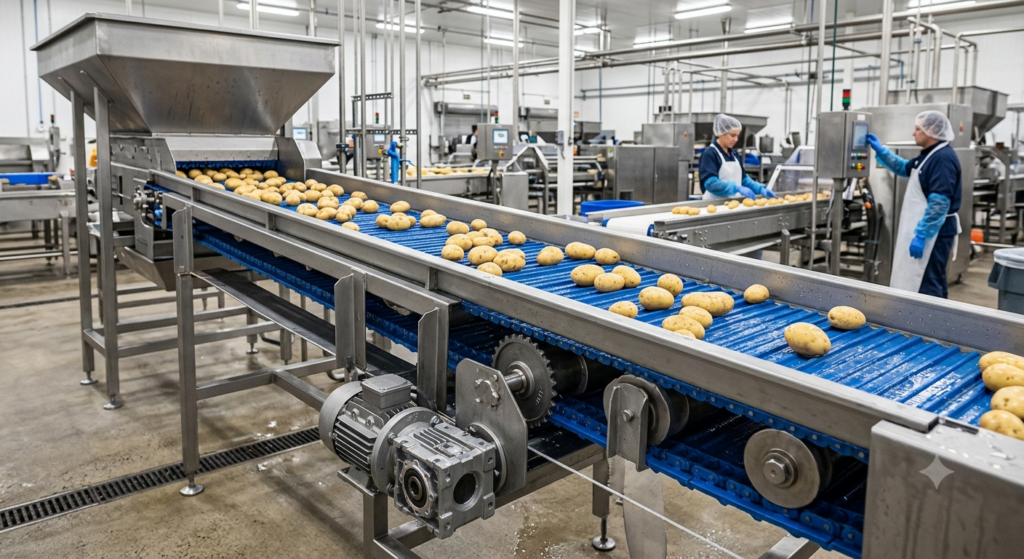
Unscheduled stoppages on a food line rarely begin with the belt itself. They begin with worn pulley lagging, fatigued bearings, or scrapers that lose edge contact under washdown stress. Each minor failure can cascade into a larger operational issue, pulling sanitation crews, maintenance teams, and shift supervisors away from production. The cost of selecting the wrong components is not limited to a single repair. It can result in lost throughput across an entire shift.
Durable belt conveyor parts help protect continuous output while maintaining sanitation integrity. When a facility specifies components engineered for cyclic loading, chemical exposure, and temperature fluctuations, maintenance windows become shorter and operational friction decreases. CONOVEY supports food processors with material handling solutions built around longevity, hygienic design, and predictable serviceability, helping plant teams keep production flowing without compromising compliance or sanitation requirements in demanding multi-shift operations.
People Also Ask
How do belt conveyor parts affect drive motor efficiency?
Belt condition, pulley alignment, and belt tension change the friction and load resistance, which directly affect how hard the drive motor must work. Poor alignment or incorrect tension increases resistance and can raise energy use while accelerating wear.
What causes belt slippage in conveyor drive systems?
Common causes include insufficient belt tension, worn pulley lagging, material buildup on the belt or pulley, and incorrect drive sizing. Slippage reduces power transfer and can contribute to heat buildup and premature component wear.
What factors determine the lifespan of an industrial conveyor belt?
Service life is influenced by belt material, load conditions, environmental exposure, conveyor/system design, and maintenance practices. Matching belt construction to the operating environment and maintaining proper tracking and tension helps extend belt life and reduce unplanned downtime.
How Belt Conveyor Parts Influence Food Processing Uptime
Worn belt conveyor parts often reveal themselves through tracking drift. A misaligned idler or fatigued return roller can pull the belt off center, triggering edge damage, product spillage, and emergency stops that interrupt packaging operations mid-cycle. Plants that monitor component condition can detect these warning signs early and avoid failures that compound throughout a shift.
Specialized conveyor accessories, such as primary and secondary belt cleaners, skirting, and impact bars, help reduce carryback that would otherwise contaminate downstream zones and accelerate roller wear. Carryback remains one of the most underestimated drivers of hygiene risk and unplanned maintenance in food processing environments.
Reliable drive mechanisms, including gearmotors, sprockets, and tensioners, help maintain steady throughput under variable loads. When drive components are properly matched to the duty cycle, operators typically experience fewer torque spikes, smoother startup, and tighter line-speed control during peak production periods.
Selecting Belt Conveyor Parts for Hygiene and Durability
Food-grade belt conveyor parts must withstand aggressive CIP cycles, caustic detergents, and high-pressure rinse routines without cracking, swelling, or harbouring bacteria. Selection begins with material chemistry. Homogeneous thermoplastics, stainless steel fasteners, and sealed bearing housings help resist microbial growth while maintaining structural integrity under heavy and uneven product loads.
Surface design is just as important as material selection. Smooth, non-porous, crevice-free conveyor components help reduce harborage sites where pathogens can accumulate, supporting sanitation protocols aligned with widely recognized food safety frameworks. Open frame designs and quick-release modules also make routine cleaning faster and more effective.
Procurement teams should evaluate conveyor components against specific environmental conditions, including moisture, fat exposure, acidic residues, temperature fluctuations between cook and chill zones, and abrasion from particulate-laden products. CONOVEY engineers automated conveyors and thermal processing solutions around these real operating conditions, helping buyers match part specifications to the demands a production line experiences every shift.
Maintaining Belt Conveyor Parts to Prevent Unscheduled Stoppages
Routine inspection remains one of the most effective ways to prevent catastrophic failures. Trained technicians can identify surface glazing, hairline cracks, lagging delamination, and bearing temperature increases long before these conditions lead to a line stoppage. An inspection schedule tied to production hours rather than calendar dates consistently outperforms reactive maintenance approaches.
Proper tensioning systems also extend the service life of components throughout the conveyor assembly. Under-tensioned belts can slip and damage drive surfaces, while over-tensioned belts place unnecessary stress on shafts, bearings, and frame welds. Automatic take-up devices and verified tensioning procedures help keep material moving efficiently while protecting every component within the load path.
Plant managers planning reliability upgrades often benefit from working with engineering teams that understand food-processing duty cycles end to end. CONOVEY works directly with operations and procurement leaders to specify belt conveyor parts, conveyor accessories, and tailored material-handling solutions that reduce the risk of downtime and support sustained, hygienic, and high-throughput production. Contact us now!


- Various Drive Options
- Tapered Rollers also available
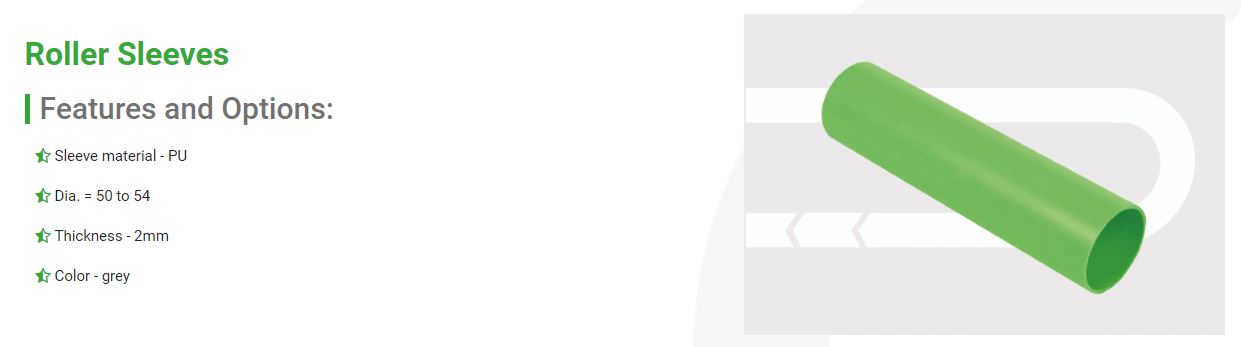
- Optional Polyurethane sleeving
- Variable speed is standard
- Safe low voltage & wide range of speeds
- 1201/1202 | Belt Rollers, Single or Double Groove Light/Medium Duty Conveyors Rollers, Custom Made Grooves | ⌀50mm Roller | ⌀11mm, ⌀14mm Shafts
- 1203 | Belt Pulley Rollers, Light/Medium Duty Conveyor Rollers | ⌀50mm Roller | ⌀11mm, ⌀14mm Shafts
- Suitable for wide range of application for Buffer or accumulation require
- Single drive with start/stop application suitable
- Single or double 14 teeth x 1/2” sprockets can be fitted (choice of steel or nylon sprockets)
- Mild steel and stainless steel options
- Stainless steel options available for all fixed driven conveyor rollers
- 1301/1302 | Polymer sprocket rollers, single or double sprocket, low running noise, polyamide bearing housing | 50mm Dia | ⌀14mm Shaft
- 1303/1304 | Steel sprocket, single or double sprocket, polyamide bearing housing | ⌀50mm Roller | ⌀14mm Shafts
- 1305/1306 | Steel sprocket, adjustable torque, single or double sprocket, polyamide/steel bearing housing | ⌀50mm, ⌀60mm, ⌀76 mm Rollers | ⌀14mm, ⌀15mm, ⌀20mm Shafts
- 1201/1202 | belt rollers, single or double groove light/medium duty conveyor rollers, custom made groove | ⌀50mm Roller | ⌀11mm, ⌀14mm Shafts
- 1203 | Belt Pulley Rollers, Light/Medium Duty Conveyor Rollers | ⌀50mm Roller | ⌀11mm, ⌀14mm Shafts
- Single and Double Grooves option
- Light and medium duty driven roller fitter with nylon O ring sprocket
- Line-shaft and 24V DC motorized rollers conveyors
- Mild steel, stainless steel and plastic options
- Stainless steel options available for all fixed driven conveyor rollers
- Free running bearings
- Wide range of tube and shaft options
- Wide range to handle from 100gm to 500kg per roller capacity
- Mild steel, stainless steel and plastic options
- Our most economical price rollers
- 1101 | PVC tube, polyamide bearing housing, light duty conveyor rollers | ⌀25mm, ⌀38mm, ⌀50mm Rollers | ⌀10mm, ⌀12mm Shafts
- 1102 | Light and medium duty universal conveyor rollers, polyamide bearing housing | ⌀25mm, ⌀38mm, ⌀50mm, ⌀76mm, ⌀89mm Rollers | ⌀14mm, ⌀20mm Shafts
- 1103 | Gravity conveyor rollers, steel bearing housing | ⌀50mm, ⌀76mm, ⌀89mm Rollers | ⌀14mm, ⌀20mm Shafts
- 1201/1202 | belt rollers, single or double groove light/medium duty conveyor rollers, custom made groove | ⌀50mm Roller | ⌀11mm, ⌀14mm Shafts
- 1203 | Belt Pulley Rollers, Light/Medium Duty Conveyor Rollers | ⌀50mm Roller | ⌀11mm, ⌀14mm Shafts
- 1204 | Poly V belt pulley rollers, medium duty and high speed conveyor rollers | ⌀50mm Roller | ⌀11mm, ⌀14mm Shafts
- 1205 | Timing belt pulley rollers, medium duty and high speed conveyor rollers | ⌀50mm Roller | ⌀11mm, ⌀14mm Shafts
- 1206/1207 | Polymer sprocket rollers, single or double sprocket, medium duty and low running noise, polyamide bearing housing | ⌀50mm Roller | ⌀14mm Shafts
- 1208/1209 | Steel sprocket, single or double sprocket, medium/heavy duty conveying application, polyamide bearing housing | ⌀50mm, ⌀60mm, ⌀76mm Rollers, ⌀89mm Roller | ⌀14mm, ⌀15mm, ⌀20mm Shafts
- 1210/1211 | Steel sprocket, steel bearing housing, heavy duty conveying, strong and reliable | ⌀50mm, ⌀76mm, ⌀89mm Rollers | ⌀14mm, ⌀15mm, ⌀20mm Shafts
- Free running option for gravity roller conveyors.
- All tapered conveyor rollers have a sealed bearing option for wash-down areas
- 50mm diameter base roller can be grooved for line-shaft conveyors
- Tapered sleeve rollers to suits an inside radius of 500mm to 1200mm
- Single or double 14 teeth x 1/2” sprockets can be fitted (choice of steel or nylon sprockets)
- Mild steel and stainless steel options
- Stainless steel options available for all fixed driven conveyor rollers
- 1401 | Gravity tapered roller, attractive look and low noise | ⌀53mm, ⌀56mm, ⌀50mm Rollers | ⌀12mm, ⌀14mm Shafts
- 1402 | belt drive, Double grooved tapered sleeve roller, customized groove position | ⌀53mm, ⌀56mm, ⌀50mm Rollers | ⌀14mm Shaft
- 1403 | belt pulley drive, Double grooved O belt pulley tapered sleeve roller | ⌀53mm, ⌀56mm, ⌀50mm Rollers | ⌀14mm Shaft
- 1404 | Poly vee belt pulley drive tapered sleeve roller, high speed, low noise | ⌀53mm, ⌀56mm, ⌀50mm Rollers | ⌀14mm Shaft
- 1405 | Polymer sprocket drive tapered sleeve roller, medium duty, low noise | ⌀53mm, ⌀56mm, ⌀50mm Rollers | ⌀14mm Shaft
- Widths | 250mm, 350mm, 450mm, 650mm, 850mm |
- Lengths | 500mm, 1000mm, 1500mm, 2000mm, 2500mm |
- Max Pallet/Carrier Wgt (kg) | 50kg/250kg |
- Pallet Sizes | 238X306, 332X430, 428X550, 522X670 |
- Height Range | 500mm - 1000mm |
- Load Accuracy | +/-0.5mm Stop Unit | +/-0.1mm Locating Pin | +/-.05mm Lift & Locate |
- Roller Pitch | 82.5mm, 127mm, 150.8mm |
- Roller ⌀ | 50mm, 76mm |
- Max Length per Drive | 7500mm |
- Drive Motor Size | .5HP, 1HP | SEW |
- Drive Speeds | 2-24 mpm
- Frame Materials | Aluminum or Powder Coat Mild Steel
- High energy efficiency level with different load application
- Safe, affordable operation without the need for guarding
- Tight positioning tolerances thanks to high precision guide rails
- Active braking and lifting of the Pallets
- Unlimited zero pressure accumulation of Pallets
- Flexible speeds from 0.2 to 24m/min between communication points
- Constant 24V auxiliary power available for energy Saving
- Very limited preventative maintenance required
- No track maintenance due to no moving parts in the track
- Very low noise level, less than 60db(A)
- Easy tracking of the Carts/parts throughout the layout
- Highly standardized components
- Significantly reduced wiring and commissioning time
- Low profile for easy part access around the line
- Tip protection for overhanging loads optionally available
- Adaptable pallet length to fit the size of your part