Why Food Processing Companies Choose Specialized Manufacturers for Sanitary Conveyor Systems

Why Food Processing Plants Choose Durable Conveyor Belt Parts to Reduce Downtime
June 9, 2026
How Modular Span Tech Systems Compare to Custom Conveyors for Material Handling
June 13, 2026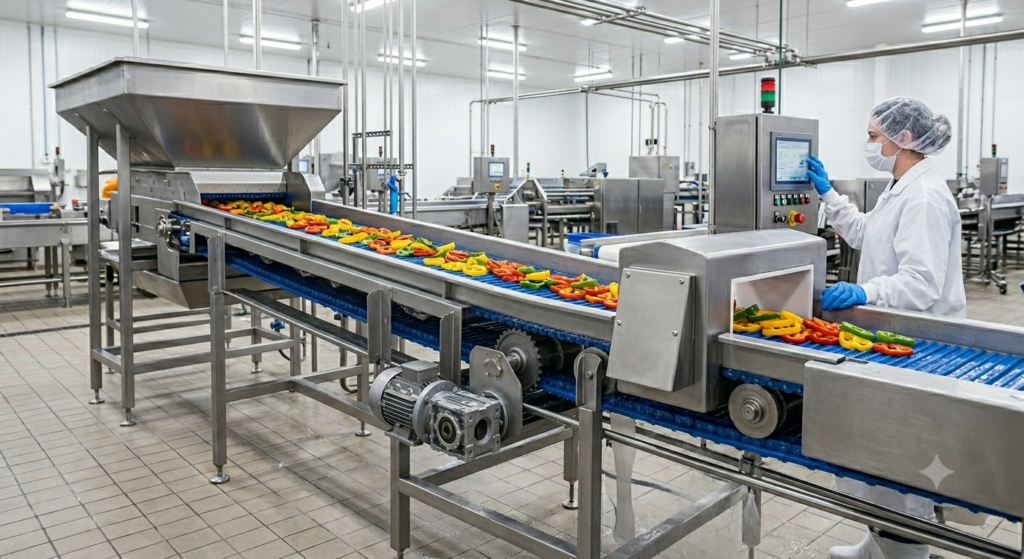
Contamination risk does not announce itself. It accumulates quietly in weld seams, drain points, and idler shafts until a product recall forces a costly rebuild of an entire production line. That silent risk is why food processors increasingly bypass generalist suppliers and engage specialized food conveyor manufacturers who design every contact surface with hygiene as the controlling variable.
Modern facilities must reconcile two pressures that often pull in opposite directions: aggressive throughput targets and uncompromising sanitation protocols. Equipment that satisfies one requirement while compromising the other is a liability. CONOVEY engineers food processing conveyor belts and integrated material handling solutions that uphold both standards simultaneously, supporting predictable washdown processes without sacrificing line speed.
Working with experienced engineers also closes the gap between procurement specifications and plant reality. Layout constraints, allergen segregation requirements, and downstream packaging logic all shape the final design, which is why specialist partnerships consistently outperform catalogue purchasing.
People Also Ask
Why do food processors use specialized food conveyor manufacturers?
Food processors work with specialized food conveyor manufacturers because these companies design systems with hygienic features such as smooth welds, open frame construction, and easy access for cleaning. These designs help reduce contamination risks while supporting efficient production.
What features should food processing conveyor belts have?
Food processing conveyor belts should be easy to clean, resistant to moisture and chemicals, and designed to withstand frequent washdown procedures. Material selection, surface finish, and durability are all important considerations.
How do sanitary conveyor systems improve food safety?
Sanitary conveyor systems reduce areas where bacteria, food residue, and moisture can accumulate. Features such as sloped surfaces, drainable frames, and tool free disassembly help support effective cleaning and sanitation practices.
Why Food Conveyor Manufacturers Prioritize Hygienic Design
Microscopic residue trapped in a single rough weld or hollow frame member can seed biofilm growth that no surface wash will displace. That single failure mode drives the entire hygienic design discipline, and it is why specialized food conveyor manufacturers treat surface finish, drainability, and access geometry as primary engineering considerations rather than aesthetic afterthoughts.
CONOVEY applies continuous smooth welds, sloped framing, and open tubular construction to eliminate the harborage points that generic equipment often overlooks. Toolless disassembly is built into the standard architecture, allowing sanitation crews to access contact surfaces, expose interior areas, and reassemble equipment without specialized tradespeople or extended line stoppages.
The trend is consistent across the industry: facilities that adopt hygienic frame geometry early often report shorter washdown windows and lower microbial swab failure rates than those retrofitting older equipment. The cost of getting this wrong is measured in lost shifts and brand damage, not simply in equipment line items.
How Food Conveyor Manufacturers Integrate Advanced Automation
Sanitation alone does not justify the capital investment. The strongest food conveyor manufacturers layer automation directly onto hygienic platforms, turning a passive transport asset into a data-generating production tool. CONOVEY integrates smart sensors to monitor bearing temperature, belt tension, and motor load, identifying wear patterns before they cause unplanned stoppages.
Automated material handling solutions also reduce operator touchpoints where contamination risks and ergonomic injuries most often originate. Vision systems, servo indexing, and zero-pressure accumulation logic move products through the line with fewer human interactions within the food zone.
Motorized roller technology deserves particular attention. It delivers precise accumulation control across delicate product streams, operates at lower temperatures than centralized drives, and is engineered for the caustic chemistry and high-pressure spray cycles common in food plant washdown environments. The tradeoff procurement teams must evaluate is the higher upfront component cost against the consistently lower lifecycle costs associated with motor replacement, gearbox rebuilds, and emergency service calls.
Selecting Food Conveyor Manufacturers for Packaging Systems
Packaging operations are often where engineering tolerances become significantly tighter. A food packaging conveyor must guide fragile, irregular, or temperature-sensitive products into precise registration with downstream wrappers, cartoners, and case packers, all without crushing, damaging, or staling the product. Generic equipment rarely manages this transition effectively.
Buyers should evaluate food conveyor manufacturers on three practical criteria: custom engineering capability, demonstrated experience with the specific product format, and the ability to integrate with existing packaging line conveyors already operating on the floor. For a deeper breakdown of evaluation frameworks, see our related guidance on automated material handling selection.
Upgrading to modular chain platforms typically provides longer service intervals, simpler belt replacement procedures, and tighter product control across curves and inclines. Procurement teams that delay this upgrade often absorb rising maintenance costs and gradual efficiency losses that compound over time until a major failure forces the decision under less favourable circumstances. For more details, contact us now!


- Various Drive Options
- Tapered Rollers also available
- Optional Polyurethane sleeving
- Variable speed is standard
- Safe low voltage & wide range of speeds
- 1201/1202 | Belt Rollers, Single or Double Groove Light/Medium Duty Conveyors Rollers, Custom Made Grooves | ⌀50mm Roller | ⌀11mm, ⌀14mm Shafts
- 1203 | Belt Pulley Rollers, Light/Medium Duty Conveyor Rollers | ⌀50mm Roller | ⌀11mm, ⌀14mm Shafts
- Suitable for wide range of application for Buffer or accumulation require
- Single drive with start/stop application suitable
- Single or double 14 teeth x 1/2” sprockets can be fitted (choice of steel or nylon sprockets)
- Mild steel and stainless steel options
- Stainless steel options available for all fixed driven conveyor rollers
- 1301/1302 | Polymer sprocket rollers, single or double sprocket, low running noise, polyamide bearing housing | 50mm Dia | ⌀14mm Shaft
- 1303/1304 | Steel sprocket, single or double sprocket, polyamide bearing housing | ⌀50mm Roller | ⌀14mm Shafts
- 1305/1306 | Steel sprocket, adjustable torque, single or double sprocket, polyamide/steel bearing housing | ⌀50mm, ⌀60mm, ⌀76 mm Rollers | ⌀14mm, ⌀15mm, ⌀20mm Shafts
- 1201/1202 | belt rollers, single or double groove light/medium duty conveyor rollers, custom made groove | ⌀50mm Roller | ⌀11mm, ⌀14mm Shafts
- 1203 | Belt Pulley Rollers, Light/Medium Duty Conveyor Rollers | ⌀50mm Roller | ⌀11mm, ⌀14mm Shafts
- Single and Double Grooves option
- Light and medium duty driven roller fitter with nylon O ring sprocket
- Line-shaft and 24V DC motorized rollers conveyors
- Mild steel, stainless steel and plastic options
- Stainless steel options available for all fixed driven conveyor rollers
- Free running bearings
- Wide range of tube and shaft options
- Wide range to handle from 100gm to 500kg per roller capacity
- Mild steel, stainless steel and plastic options
- Our most economical price rollers
- 1101 | PVC tube, polyamide bearing housing, light duty conveyor rollers | ⌀25mm, ⌀38mm, ⌀50mm Rollers | ⌀10mm, ⌀12mm Shafts
- 1102 | Light and medium duty universal conveyor rollers, polyamide bearing housing | ⌀25mm, ⌀38mm, ⌀50mm, ⌀76mm, ⌀89mm Rollers | ⌀14mm, ⌀20mm Shafts
- 1103 | Gravity conveyor rollers, steel bearing housing | ⌀50mm, ⌀76mm, ⌀89mm Rollers | ⌀14mm, ⌀20mm Shafts
- 1201/1202 | belt rollers, single or double groove light/medium duty conveyor rollers, custom made groove | ⌀50mm Roller | ⌀11mm, ⌀14mm Shafts
- 1203 | Belt Pulley Rollers, Light/Medium Duty Conveyor Rollers | ⌀50mm Roller | ⌀11mm, ⌀14mm Shafts
- 1204 | Poly V belt pulley rollers, medium duty and high speed conveyor rollers | ⌀50mm Roller | ⌀11mm, ⌀14mm Shafts
- 1205 | Timing belt pulley rollers, medium duty and high speed conveyor rollers | ⌀50mm Roller | ⌀11mm, ⌀14mm Shafts
- 1206/1207 | Polymer sprocket rollers, single or double sprocket, medium duty and low running noise, polyamide bearing housing | ⌀50mm Roller | ⌀14mm Shafts
- 1208/1209 | Steel sprocket, single or double sprocket, medium/heavy duty conveying application, polyamide bearing housing | ⌀50mm, ⌀60mm, ⌀76mm Rollers, ⌀89mm Roller | ⌀14mm, ⌀15mm, ⌀20mm Shafts
- 1210/1211 | Steel sprocket, steel bearing housing, heavy duty conveying, strong and reliable | ⌀50mm, ⌀76mm, ⌀89mm Rollers | ⌀14mm, ⌀15mm, ⌀20mm Shafts
- Free running option for gravity roller conveyors.
- All tapered conveyor rollers have a sealed bearing option for wash-down areas
- 50mm diameter base roller can be grooved for line-shaft conveyors
- Tapered sleeve rollers to suits an inside radius of 500mm to 1200mm
- Single or double 14 teeth x 1/2” sprockets can be fitted (choice of steel or nylon sprockets)
- Mild steel and stainless steel options
- Stainless steel options available for all fixed driven conveyor rollers
- 1401 | Gravity tapered roller, attractive look and low noise | ⌀53mm, ⌀56mm, ⌀50mm Rollers | ⌀12mm, ⌀14mm Shafts
- 1402 | belt drive, Double grooved tapered sleeve roller, customized groove position | ⌀53mm, ⌀56mm, ⌀50mm Rollers | ⌀14mm Shaft
- 1403 | belt pulley drive, Double grooved O belt pulley tapered sleeve roller | ⌀53mm, ⌀56mm, ⌀50mm Rollers | ⌀14mm Shaft
- 1404 | Poly vee belt pulley drive tapered sleeve roller, high speed, low noise | ⌀53mm, ⌀56mm, ⌀50mm Rollers | ⌀14mm Shaft
- 1405 | Polymer sprocket drive tapered sleeve roller, medium duty, low noise | ⌀53mm, ⌀56mm, ⌀50mm Rollers | ⌀14mm Shaft
- Widths | 250mm, 350mm, 450mm, 650mm, 850mm |
- Lengths | 500mm, 1000mm, 1500mm, 2000mm, 2500mm |
- Max Pallet/Carrier Wgt (kg) | 50kg/250kg |
- Pallet Sizes | 238X306, 332X430, 428X550, 522X670 |
- Height Range | 500mm - 1000mm |
- Load Accuracy | +/-0.5mm Stop Unit | +/-0.1mm Locating Pin | +/-.05mm Lift & Locate |
- Roller Pitch | 82.5mm, 127mm, 150.8mm |
- Roller ⌀ | 50mm, 76mm |
- Max Length per Drive | 7500mm |
- Drive Motor Size | .5HP, 1HP | SEW |
- Drive Speeds | 2-24 mpm
- Frame Materials | Aluminum or Powder Coat Mild Steel
- High energy efficiency level with different load application
- Safe, affordable operation without the need for guarding
- Tight positioning tolerances thanks to high precision guide rails
- Active braking and lifting of the Pallets
- Unlimited zero pressure accumulation of Pallets
- Flexible speeds from 0.2 to 24m/min between communication points
- Constant 24V auxiliary power available for energy Saving
- Very limited preventative maintenance required
- No track maintenance due to no moving parts in the track
- Very low noise level, less than 60db(A)
- Easy tracking of the Carts/parts throughout the layout
- Highly standardized components
- Significantly reduced wiring and commissioning time
- Low profile for easy part access around the line
- Tip protection for overhanging loads optionally available
- Adaptable pallet length to fit the size of your part