Industrial Conveyor Belts Explained: Types, Materials, and Application-Specific Performance

How Conveyor System Manufacturers Integrate Belts, Rollers, and Drives
February 13, 2026
Conovey’s Guide: 5 Steps to Perfect Conveyor Speed & Boost Output
March 2, 2026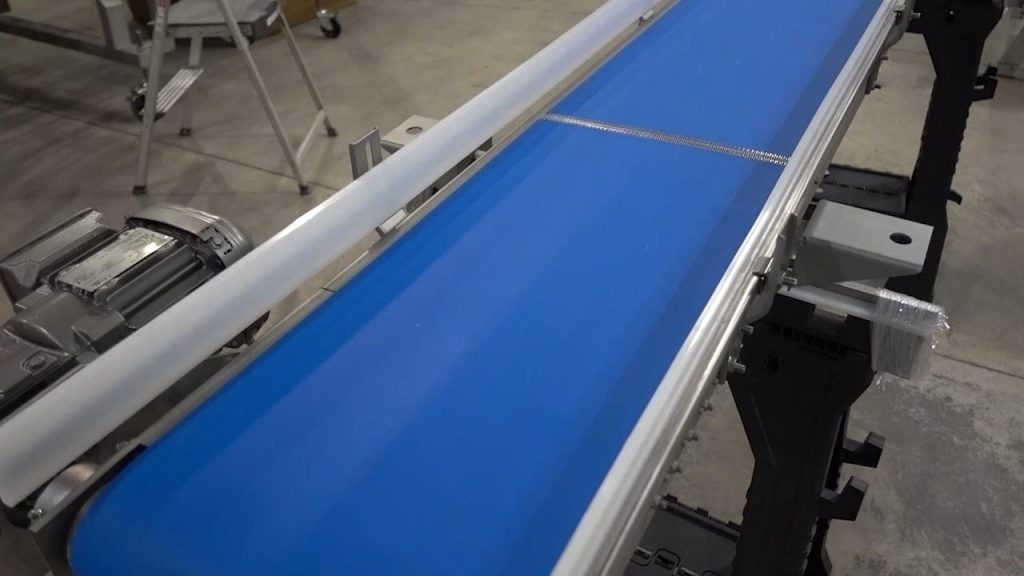
Across manufacturing floors, warehouses, processing plants, and distribution centers, conveyor belts quietly determine how efficiently materials move from one stage to the next. Throughput targets, labor efficiency, equipment uptime, and even product quality are all influenced by how well a conveyor belt performs under real operating conditions. For any industrial conveyor manufacturer, belt selection is not a secondary detail. It is a core design decision that directly affects system reliability and operating cost.
Industrial conveyor belts are not interchangeable components. Differences in material, construction, surface design, and mechanical behavior mean that each belt type performs best within a specific operating window. Understanding these differences helps operations align belt choice with application demands, rather than forcing a general-purpose solution into a specialized role.
People Also Ask
1. What factors determine the lifespan of an industrial conveyor belt?
Belt material, load conditions, environmental exposure, system design, and maintenance practices all influence service life.
2. How does conveyor design affect belt performance?
Pulley sizing, alignment, tensioning, and transfer design directly impact wear patterns, tracking stability, and overall belt reliability.
What Is an Industrial Conveyor Belt?
An industrial conveyor belt is a continuous loop of material used to transport products, parts, or bulk materials along a conveyor system. The belt rides on rollers or a slider bed and is driven by a powered pulley system. Its function is simple in principle, but performance depends heavily on how well the belt matches the application’s load, speed, environment, and duty cycle.
Unlike light-duty belts, industrial conveyor belts are engineered for continuous operation, higher loads, and long service life under demanding conditions.
Key Performance Factors in Industrial Conveyor Belts
Several performance factors define how a belt behaves in service:
- Tensile strength and elongation resistance
- Surface friction and product grip
- Resistance to abrasion, heat, moisture, or chemicals
- Flexibility around pulleys and curves
- Compatibility with the conveyor machine design
Balancing these factors is essential to avoid premature wear, tracking issues, or excessive maintenance.
Main Types of Industrial Conveyor Belts
Industrial conveyor belts generally fall into three broad categories: rubber belts, modular plastic belts, and metal belts. Each category addresses different operational priorities and environmental constraints.
Understanding these categories helps narrow down belt options before evaluating material and construction details.
1. Rubber Conveyor Belts: Strength and Versatility
Rubber conveyor belts remain one of the most widely used options in industrial environments. They are valued for strength, shock absorption, and adaptability across multiple industries.
Rubber belts perform well in applications involving bulk material handling, heavy loads, and abrasive products. Reinforced constructions using fabric or steel cords increase tensile strength and control elongation under load.
Their versatility makes rubber belts common in mining, aggregates, recycling, and general manufacturing operations.
2. Modular Plastic Conveyor Belts: Flexibility and Hygiene
Modular plastic belts are constructed from interlocking plastic modules rather than a continuous sheet. This design enables airflow and drainage and facilitates easy replacement of damaged sections.
These belts are frequently selected for applications requiring frequent cleaning or washdown. Food processing, packaging, and pharmaceutical operations benefit from their corrosion resistance and hygienic surfaces.
Modular belts also support tight turns and elevation changes, making them suitable for compact conveyor machine layouts.
3. Metal Conveyor Belts: High-Temperature and Heavy-Duty Use
Metal conveyor belts are engineered for extreme conditions where rubber or plastic would fail. They are commonly made from stainless steel or other high-strength alloys.
These belts excel in high-temperature environments, including ovens, heat-treatment lines, and drying systems. They also support heavy loads and sharp or abrasive products.
While metal belts require higher upfront investment, their durability supports long-term operation in demanding applications.
Belt Materials and Their Performance Characteristics
Material selection defines how a belt performs under stress. Rubber compounds vary in hardness, abrasion resistance, and chemical compatibility. Plastic materials differ in temperature tolerance, flexibility, and impact resistance. Metal alloys provide strength, corrosion resistance, and thermal stability.
Choosing the right material involves matching belt properties with product characteristics and operating conditions rather than relying on general assumptions.
Application-Specific Conveyor Belt Performance
Different applications place different demands on an industrial conveyor belt:
- Bulk handling requires high tensile strength and abrasion resistance
- Packaging lines prioritize smooth surfaces and consistent speed
- Food processing demands hygiene and corrosion resistance
- Heavy manufacturing needs load stability and impact tolerance
A belt that performs well in one application may fail quickly in another if these factors are overlooked.
Environmental and Operating Conditions That Influence Belt Choice
Temperature, humidity, dust, oils, and chemicals all affect belt performance. Cold environments increase stiffness, whereas high temperatures accelerate material degradation. Moisture and chemicals can weaken certain materials or affect surface friction.
Evaluating environmental exposure is essential to prevent unexpected belt failure or excessive maintenance.
Belt Tracking, Tensioning, and Wear Considerations
Proper tracking and tensioning are critical to belt life. Insufficient tension leads to slippage, while excessive tension accelerates wear and stresses mechanical components.
Belt wear often first appears at the edges, splice points, or high-friction zones. These patterns provide insight into alignment and loading conditions that may need correction.
Maintenance and Lifecycle Expectations
Industrial conveyor belts are wear components, but service life varies widely depending on selection and operating conditions. Routine inspection, cleaning, and tension checks extend belt life and reduce unplanned downtime.
A belt selected with lifecycle cost in mind often delivers better long-term value than a lower-cost option that requires frequent replacement.
Common Mistakes When Selecting Industrial Conveyor Belts
Common selection errors include oversizing belts for light-duty applications, underestimating environmental exposure, and ignoring compatibility with the conveyor machine design.
Another frequent mistake is focusing on initial cost rather than the total cost of ownership, which includes maintenance, downtime, and replacement frequency.
How Conveyor System Design Influences Belt Performance
Belt performance is inseparable from system design. Pulley diameter, roller spacing, drive configuration, and transfer points all affect how a belt behaves in service.
Well-designed systems distribute load evenly, minimize friction, and support stable tracking. Poor design amplifies wear and reduces belt life regardless of material quality.
Selecting the Right Industrial Conveyor Belt for Long-Term Performance
Industrial conveyor belts perform best when integrated into a system rather than used as standalone components. Material choice, construction, environmental exposure, and system design all interact to determine reliability and cost over time. Conovey works with industrial operations to engineer conveyor solutions that align belt performance with real operating demands.
Connect with Conovey to partner with a conveyor company that prioritizes durability, efficiency, and long-term system value.


- Various Drive Options
- Tapered Rollers also available
- Optional Polyurethane sleeving
- Variable speed is standard
- Safe low voltage & wide range of speeds
- 1201/1202 | Belt Rollers, Single or Double Groove Light/Medium Duty Conveyors Rollers, Custom Made Grooves | ⌀50mm Roller | ⌀11mm, ⌀14mm Shafts
- 1203 | Belt Pulley Rollers, Light/Medium Duty Conveyor Rollers | ⌀50mm Roller | ⌀11mm, ⌀14mm Shafts
- Suitable for wide range of application for Buffer or accumulation require
- Single drive with start/stop application suitable
- Single or double 14 teeth x 1/2” sprockets can be fitted (choice of steel or nylon sprockets)
- Mild steel and stainless steel options
- Stainless steel options available for all fixed driven conveyor rollers
- 1301/1302 | Polymer sprocket rollers, single or double sprocket, low running noise, polyamide bearing housing | 50mm Dia | ⌀14mm Shaft
- 1303/1304 | Steel sprocket, single or double sprocket, polyamide bearing housing | ⌀50mm Roller | ⌀14mm Shafts
- 1305/1306 | Steel sprocket, adjustable torque, single or double sprocket, polyamide/steel bearing housing | ⌀50mm, ⌀60mm, ⌀76 mm Rollers | ⌀14mm, ⌀15mm, ⌀20mm Shafts
- 1201/1202 | belt rollers, single or double groove light/medium duty conveyor rollers, custom made groove | ⌀50mm Roller | ⌀11mm, ⌀14mm Shafts
- 1203 | Belt Pulley Rollers, Light/Medium Duty Conveyor Rollers | ⌀50mm Roller | ⌀11mm, ⌀14mm Shafts
- Single and Double Grooves option
- Light and medium duty driven roller fitter with nylon O ring sprocket
- Line-shaft and 24V DC motorized rollers conveyors
- Mild steel, stainless steel and plastic options
- Stainless steel options available for all fixed driven conveyor rollers
- Free running bearings
- Wide range of tube and shaft options
- Wide range to handle from 100gm to 500kg per roller capacity
- Mild steel, stainless steel and plastic options
- Our most economical price rollers
- 1101 | PVC tube, polyamide bearing housing, light duty conveyor rollers | ⌀25mm, ⌀38mm, ⌀50mm Rollers | ⌀10mm, ⌀12mm Shafts
- 1102 | Light and medium duty universal conveyor rollers, polyamide bearing housing | ⌀25mm, ⌀38mm, ⌀50mm, ⌀76mm, ⌀89mm Rollers | ⌀14mm, ⌀20mm Shafts
- 1103 | Gravity conveyor rollers, steel bearing housing | ⌀50mm, ⌀76mm, ⌀89mm Rollers | ⌀14mm, ⌀20mm Shafts
- 1201/1202 | belt rollers, single or double groove light/medium duty conveyor rollers, custom made groove | ⌀50mm Roller | ⌀11mm, ⌀14mm Shafts
- 1203 | Belt Pulley Rollers, Light/Medium Duty Conveyor Rollers | ⌀50mm Roller | ⌀11mm, ⌀14mm Shafts
- 1204 | Poly V belt pulley rollers, medium duty and high speed conveyor rollers | ⌀50mm Roller | ⌀11mm, ⌀14mm Shafts
- 1205 | Timing belt pulley rollers, medium duty and high speed conveyor rollers | ⌀50mm Roller | ⌀11mm, ⌀14mm Shafts
- 1206/1207 | Polymer sprocket rollers, single or double sprocket, medium duty and low running noise, polyamide bearing housing | ⌀50mm Roller | ⌀14mm Shafts
- 1208/1209 | Steel sprocket, single or double sprocket, medium/heavy duty conveying application, polyamide bearing housing | ⌀50mm, ⌀60mm, ⌀76mm Rollers, ⌀89mm Roller | ⌀14mm, ⌀15mm, ⌀20mm Shafts
- 1210/1211 | Steel sprocket, steel bearing housing, heavy duty conveying, strong and reliable | ⌀50mm, ⌀76mm, ⌀89mm Rollers | ⌀14mm, ⌀15mm, ⌀20mm Shafts
- Free running option for gravity roller conveyors.
- All tapered conveyor rollers have a sealed bearing option for wash-down areas
- 50mm diameter base roller can be grooved for line-shaft conveyors
- Tapered sleeve rollers to suits an inside radius of 500mm to 1200mm
- Single or double 14 teeth x 1/2” sprockets can be fitted (choice of steel or nylon sprockets)
- Mild steel and stainless steel options
- Stainless steel options available for all fixed driven conveyor rollers
- 1401 | Gravity tapered roller, attractive look and low noise | ⌀53mm, ⌀56mm, ⌀50mm Rollers | ⌀12mm, ⌀14mm Shafts
- 1402 | belt drive, Double grooved tapered sleeve roller, customized groove position | ⌀53mm, ⌀56mm, ⌀50mm Rollers | ⌀14mm Shaft
- 1403 | belt pulley drive, Double grooved O belt pulley tapered sleeve roller | ⌀53mm, ⌀56mm, ⌀50mm Rollers | ⌀14mm Shaft
- 1404 | Poly vee belt pulley drive tapered sleeve roller, high speed, low noise | ⌀53mm, ⌀56mm, ⌀50mm Rollers | ⌀14mm Shaft
- 1405 | Polymer sprocket drive tapered sleeve roller, medium duty, low noise | ⌀53mm, ⌀56mm, ⌀50mm Rollers | ⌀14mm Shaft
- Widths | 250mm, 350mm, 450mm, 650mm, 850mm |
- Lengths | 500mm, 1000mm, 1500mm, 2000mm, 2500mm |
- Max Pallet/Carrier Wgt (kg) | 50kg/250kg |
- Pallet Sizes | 238X306, 332X430, 428X550, 522X670 |
- Height Range | 500mm - 1000mm |
- Load Accuracy | +/-0.5mm Stop Unit | +/-0.1mm Locating Pin | +/-.05mm Lift & Locate |
- Roller Pitch | 82.5mm, 127mm, 150.8mm |
- Roller ⌀ | 50mm, 76mm |
- Max Length per Drive | 7500mm |
- Drive Motor Size | .5HP, 1HP | SEW |
- Drive Speeds | 2-24 mpm
- Frame Materials | Aluminum or Powder Coat Mild Steel
- High energy efficiency level with different load application
- Safe, affordable operation without the need for guarding
- Tight positioning tolerances thanks to high precision guide rails
- Active braking and lifting of the Pallets
- Unlimited zero pressure accumulation of Pallets
- Flexible speeds from 0.2 to 24m/min between communication points
- Constant 24V auxiliary power available for energy Saving
- Very limited preventative maintenance required
- No track maintenance due to no moving parts in the track
- Very low noise level, less than 60db(A)
- Easy tracking of the Carts/parts throughout the layout
- Highly standardized components
- Significantly reduced wiring and commissioning time
- Low profile for easy part access around the line
- Tip protection for overhanging loads optionally available
- Adaptable pallet length to fit the size of your part