How Conveyor System Manufacturers Integrate Belts, Rollers, and Drives

How to Choose the Best Custom-Built Conveyors Suppliers in Ontario
February 10, 2026
Industrial Conveyor Belts Explained: Types, Materials, and Application-Specific Performance
February 17, 2026
Industrial conveyor systems succeed or fail based on how well their core components work together. Belts, rollers, and drives may appear to be independent elements, but performance depends on how effectively these parts are engineered as a single system. This integrated approach is a defining characteristic of the best conveyor system manufacturers for industrial uses, especially in environments where uptime, load consistency, and long service life are critical.
Rather than selecting components in isolation, leading manufacturers design conveyors around system-level interaction. Load behavior, friction, speed, and power transfer are evaluated together to ensure that every component supports the others. This approach reduces wear, improves efficiency, and delivers predictable performance across demanding industrial applications.
Understanding the Core Components of a Conveyor System
A conveyor system typically consists of a conveying surface, support structure, rollers or idlers, and a drive assembly. Belts provide the transport medium, rollers support and guide movement, and drives supply the power that moves material through the system.
When these components are not properly matched, issues such as slippage, uneven wear, and excessive energy consumption become unavoidable.
System-Level Engineering: Designing Belts, Rollers, and Drives Together
Conveyor system manufacturers use a design approach that starts at the system level. Load weight, product dimensions, duty cycle, and environmental conditions inform every design decision. Belts, rollers, and drives are selected and sized together to balance tension, traction, and throughput.
This approach avoids the common pitfall of retrofitting mismatched components into a fixed layout.
How Conveyor Belts Are Selected and Integrated
Belt selection depends on material type, surface requirements, speed, and environmental exposure. Thickness, tensile strength, and surface finish must align with roller spacing and drive torque.
Integration involves ensuring proper belt tracking, tension control, and compatibility with pulleys and rollers to maintain stable operation.
The Role of Rollers in Conveyor System Integration
Rollers influence friction, alignment, and load distribution. Spacing, diameter, and bearing selection affect how evenly loads are carried and how smoothly belts move.
Integrated designs ensure that rollers support the belt without introducing excessive resistance or localized stress that shortens component life.
Drive System Design and Integration
Drive systems convert electrical power into controlled motion. Motors, gearboxes, and couplings are selected based on load requirements and belt characteristics.
Proper integration ensures that drives deliver consistent torque without overloading belts or rollers during start-up, operation, or shutdown.
Power Transmission and Load Distribution
Power transmission must be evenly distributed across the conveyor length. Poor distribution leads to slippage at the drive pulley or excessive tension at transfer points.
Manufacturers account for friction losses, elevation changes, and load accumulation to maintain balanced power flow.
Speed Control and Synchronization Across the Conveyor
Speed consistency is essential for downstream processes. Drives, belts, and rollers must operate in sync to prevent product bunching or gaps.
Variable speed controls are integrated to manage acceleration and deceleration without stressing mechanical components.
Integration With Controls and Automation
Modern conveyors often interface with sensors, PLCs, and automated equipment. Integrated design ensures that the mechanical response accurately matches control signals.
This alignment supports smooth starts, controlled stops, and safe operation in automated environments.
Common Integration Challenges Manufacturers Must Solve
Challenges include managing changes in belt tension, accommodating varying load conditions, and protecting components from environmental exposure.
Experienced manufacturers address these challenges during design rather than after installation.
Design Practices That Improve Reliability and Service Life
Practices such as conservative load calculations, proper alignment, and accessible maintenance points improve reliability.
Integrated component selection reduces the likelihood of premature failure and unplanned downtime.
Testing, Validation, and Commissioning
Before commissioning, systems are tested under expected operating conditions. Validation confirms that belts track correctly, rollers rotate freely, and drives deliver consistent power.
This process ensures performance matches design intent.
Maintenance Considerations for Integrated Conveyor Systems
Integrated systems simplify maintenance by reducing conflicting wear patterns. Predictable component behavior allows for scheduled inspections and part replacement.
Why Integrated Design Improves ROI
Integrated conveyor systems deliver higher uptime, lower maintenance costs, and longer service life. These benefits translate directly into improved return on investment for industrial operations.
Conveyor Systems Work Best When Designed as One
Effective conveyor performance depends on designing belts, rollers, and drives as a unified system. This integrated approach minimizes wear, improves efficiency, and supports long-term reliability. Conovey delivers engineered conveyor solutions built around system-level integration for demanding industrial environments.
Connect with Conovey to work with one of the best conveyor system manufacturers for industrial uses and implement solutions designed for performance and longevity.


- Various Drive Options
- Tapered Rollers also available
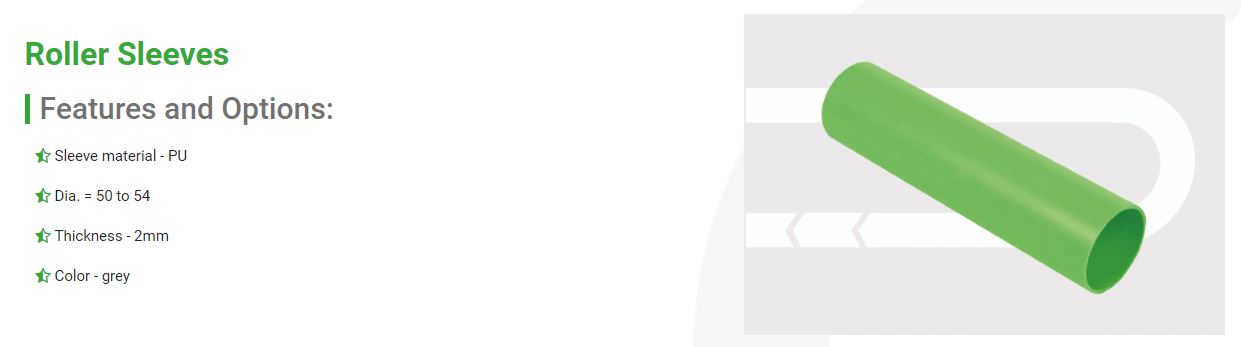
- Optional Polyurethane sleeving
- Variable speed is standard
- Safe low voltage & wide range of speeds
- 1201/1202 | Belt Rollers, Single or Double Groove Light/Medium Duty Conveyors Rollers, Custom Made Grooves | ⌀50mm Roller | ⌀11mm, ⌀14mm Shafts
- 1203 | Belt Pulley Rollers, Light/Medium Duty Conveyor Rollers | ⌀50mm Roller | ⌀11mm, ⌀14mm Shafts
- Suitable for wide range of application for Buffer or accumulation require
- Single drive with start/stop application suitable
- Single or double 14 teeth x 1/2” sprockets can be fitted (choice of steel or nylon sprockets)
- Mild steel and stainless steel options
- Stainless steel options available for all fixed driven conveyor rollers
- 1301/1302 | Polymer sprocket rollers, single or double sprocket, low running noise, polyamide bearing housing | 50mm Dia | ⌀14mm Shaft
- 1303/1304 | Steel sprocket, single or double sprocket, polyamide bearing housing | ⌀50mm Roller | ⌀14mm Shafts
- 1305/1306 | Steel sprocket, adjustable torque, single or double sprocket, polyamide/steel bearing housing | ⌀50mm, ⌀60mm, ⌀76 mm Rollers | ⌀14mm, ⌀15mm, ⌀20mm Shafts
- 1201/1202 | belt rollers, single or double groove light/medium duty conveyor rollers, custom made groove | ⌀50mm Roller | ⌀11mm, ⌀14mm Shafts
- 1203 | Belt Pulley Rollers, Light/Medium Duty Conveyor Rollers | ⌀50mm Roller | ⌀11mm, ⌀14mm Shafts
- Single and Double Grooves option
- Light and medium duty driven roller fitter with nylon O ring sprocket
- Line-shaft and 24V DC motorized rollers conveyors
- Mild steel, stainless steel and plastic options
- Stainless steel options available for all fixed driven conveyor rollers
- Free running bearings
- Wide range of tube and shaft options
- Wide range to handle from 100gm to 500kg per roller capacity
- Mild steel, stainless steel and plastic options
- Our most economical price rollers
- 1101 | PVC tube, polyamide bearing housing, light duty conveyor rollers | ⌀25mm, ⌀38mm, ⌀50mm Rollers | ⌀10mm, ⌀12mm Shafts
- 1102 | Light and medium duty universal conveyor rollers, polyamide bearing housing | ⌀25mm, ⌀38mm, ⌀50mm, ⌀76mm, ⌀89mm Rollers | ⌀14mm, ⌀20mm Shafts
- 1103 | Gravity conveyor rollers, steel bearing housing | ⌀50mm, ⌀76mm, ⌀89mm Rollers | ⌀14mm, ⌀20mm Shafts
- 1201/1202 | belt rollers, single or double groove light/medium duty conveyor rollers, custom made groove | ⌀50mm Roller | ⌀11mm, ⌀14mm Shafts
- 1203 | Belt Pulley Rollers, Light/Medium Duty Conveyor Rollers | ⌀50mm Roller | ⌀11mm, ⌀14mm Shafts
- 1204 | Poly V belt pulley rollers, medium duty and high speed conveyor rollers | ⌀50mm Roller | ⌀11mm, ⌀14mm Shafts
- 1205 | Timing belt pulley rollers, medium duty and high speed conveyor rollers | ⌀50mm Roller | ⌀11mm, ⌀14mm Shafts
- 1206/1207 | Polymer sprocket rollers, single or double sprocket, medium duty and low running noise, polyamide bearing housing | ⌀50mm Roller | ⌀14mm Shafts
- 1208/1209 | Steel sprocket, single or double sprocket, medium/heavy duty conveying application, polyamide bearing housing | ⌀50mm, ⌀60mm, ⌀76mm Rollers, ⌀89mm Roller | ⌀14mm, ⌀15mm, ⌀20mm Shafts
- 1210/1211 | Steel sprocket, steel bearing housing, heavy duty conveying, strong and reliable | ⌀50mm, ⌀76mm, ⌀89mm Rollers | ⌀14mm, ⌀15mm, ⌀20mm Shafts
- Free running option for gravity roller conveyors.
- All tapered conveyor rollers have a sealed bearing option for wash-down areas
- 50mm diameter base roller can be grooved for line-shaft conveyors
- Tapered sleeve rollers to suits an inside radius of 500mm to 1200mm
- Single or double 14 teeth x 1/2” sprockets can be fitted (choice of steel or nylon sprockets)
- Mild steel and stainless steel options
- Stainless steel options available for all fixed driven conveyor rollers
- 1401 | Gravity tapered roller, attractive look and low noise | ⌀53mm, ⌀56mm, ⌀50mm Rollers | ⌀12mm, ⌀14mm Shafts
- 1402 | belt drive, Double grooved tapered sleeve roller, customized groove position | ⌀53mm, ⌀56mm, ⌀50mm Rollers | ⌀14mm Shaft
- 1403 | belt pulley drive, Double grooved O belt pulley tapered sleeve roller | ⌀53mm, ⌀56mm, ⌀50mm Rollers | ⌀14mm Shaft
- 1404 | Poly vee belt pulley drive tapered sleeve roller, high speed, low noise | ⌀53mm, ⌀56mm, ⌀50mm Rollers | ⌀14mm Shaft
- 1405 | Polymer sprocket drive tapered sleeve roller, medium duty, low noise | ⌀53mm, ⌀56mm, ⌀50mm Rollers | ⌀14mm Shaft
- Widths | 250mm, 350mm, 450mm, 650mm, 850mm |
- Lengths | 500mm, 1000mm, 1500mm, 2000mm, 2500mm |
- Max Pallet/Carrier Wgt (kg) | 50kg/250kg |
- Pallet Sizes | 238X306, 332X430, 428X550, 522X670 |
- Height Range | 500mm - 1000mm |
- Load Accuracy | +/-0.5mm Stop Unit | +/-0.1mm Locating Pin | +/-.05mm Lift & Locate |
- Roller Pitch | 82.5mm, 127mm, 150.8mm |
- Roller ⌀ | 50mm, 76mm |
- Max Length per Drive | 7500mm |
- Drive Motor Size | .5HP, 1HP | SEW |
- Drive Speeds | 2-24 mpm
- Frame Materials | Aluminum or Powder Coat Mild Steel
- High energy efficiency level with different load application
- Safe, affordable operation without the need for guarding
- Tight positioning tolerances thanks to high precision guide rails
- Active braking and lifting of the Pallets
- Unlimited zero pressure accumulation of Pallets
- Flexible speeds from 0.2 to 24m/min between communication points
- Constant 24V auxiliary power available for energy Saving
- Very limited preventative maintenance required
- No track maintenance due to no moving parts in the track
- Very low noise level, less than 60db(A)
- Easy tracking of the Carts/parts throughout the layout
- Highly standardized components
- Significantly reduced wiring and commissioning time
- Low profile for easy part access around the line
- Tip protection for overhanging loads optionally available
- Adaptable pallet length to fit the size of your part